

|
| Opened to the public Feb. 28, 2026 |

|
| Opened to the public Mar. 7, 2026 |

|
| Opened to the public Mar. 21, 2026 |

|
| Opened to the public Mar. 28, 2026 |
• Patreon Release Date: February 28, 2025
• Public Release Date: February 28, 2026.
• Patreon Release Date: March 7, 2025
• Public Release Date: March 7, 2026.
• Patreon Release Date: March 21, 2025
• Public Release Date: March 21, 2026.
• Patreon Release Date: March 28, 2025
• Public Release Date: March 28, 2026.
Please tell your friends that they can subscribe to my Patreon stream for $8.00 per month:
•
"It's All Ephemera with Cat Yronwode"
Please tell your friends that they can subscribe to my Patreon stream for $8.00 per month:
•
"It's All Ephemera with Cat Yronwode"
Support YIPPIE
All of the material you have access to here — the historical information researched and shared from the mind of the woman who is making it all happen — can easily fit into one 8 x 10 foot room in an old Victorian farmhouse, but you would never see it without the investment of the time it takes to produce such a site and the caloric input such a site requires in the form of food for the writer, graphic designer, and database manager, as well as the US currency needed to pay for the computers, software applications, scanners, electricity, and internet connectivity that bring it out of that little room and into the world. So although it is "free," there also is a cost. Your financial support underwrites this cost. Each new web page is circulated to Patrons as an advance copy. After one year access for Patrons, each page is released to the public. Patrons have access to a Private Patreon sub-forum within the Lucky Mojo Forum, and are accorded special Red Star Avatar badges at the Forum.
Books About Divining Rods, Dowsing, Doodlebugging, Water Witching. Rhabdomancy, Radiesthesia, Radionics, and Pendulum Divination
A bibliography compiled by catherine yronwode
The Divining Rods, Dowsing, Doodlebugging, Water Witching, Rhabdomancy, Radiesthesia, Radionics, and Pendulum Divination Bibliography is copyright 2010 by the Yronwode Institution for the Preservation and Popularization of Indigenous Ethnomagicology (Y.I.P.P.I.E.), and all rights are reserved. In other words, you may download The Divining Rods, Dowsing, Doodlebugging, Water Witching, Rhabdomancy, Radiesthesia, Radionics, and Pendulum Divination Bibliography and print it out at home for your own use, but you may not further copy it, because the copyright holder controls the copying rights. Specifically, you may not mirror The Divining Rods, Dowsing, Doodlebugging, Water Witching, Rhabdomancy, Radiesthesia, Radionics, and Pendulum Divination Bibliography to other web sites, you may not distribute it or publish it in print form (either for money or for free), and you may not electronically distribute it in e-lists, electronic forums, social media groups, or usenet (either for money or for free) without the express written permission of the copyright holder.
Compiler's Note on the Contents of This Bibliography:
The books and periodicals included in this bibliography cover a fairly large and overlapping -- but not always compatible -- array of foundational beliefs, objectives, methods, and tools regarding Divining Rods, Dowsing, Doodlebugging, Water Witching, Rhabdomancy, Radiesthesia, Radionics, and Pendulum Divination. The paucity of books after 1990 reflects the approximate era of the final and firm split between two previously co-existing theories of what dowsing actually is and how it is done.
These two schools of thought are:
• "Practical Dowsing" or "Old-School Dowsing": A school of dowsing primarily based on the theory that an as-yet-unquantified ability is possessed in varying degrees by certain animals (including human beings) to perceive and process natural electrical and magnetic information.
• "Psychic Dowsing" or "New Age Dowsing": A school of dowsing primarily based on metaphysical beliefs and practices that include, but are not limited to, the theory that information about hidden things is transmitted to human beings by discarnate entities, spiritual guides, and divinities.
This bibliography deals primarily with the Practical school of dowsing, as this was the first school established, and the dominant one from the 16th through the 20th centuries. The Psychic school of dowsing, which arose in the late 20th century and has so far dominated 21st century dowsing, has produced its own full library of books, and they are being added here as they come to my attention, but unless copies are offered to me for listing and review, a complete listing of books on psychic dowsing, may become a job for another bibliographer.
Basic Concepts Associated with the Topic of Dowsing:
FOUNDATIONAL BELIEFS:
Dowsers base their work on a variety of beliefs and traditions, which may -- or may NOT -- include:• Active Dowsing: The belief that dowsing tools, like domestic animals, are allies that can and should be "trained" to work for the dowser, who is the active participant.
• Passive Dowsing: The belief that higher forces, divine spirits, or astral energies guide the tools and that the dowser's main task is to be submissively receptive.
• Psychological Dowsing: The belief that the act of dowsing consists of us asking our own brains for knowledge which we are not conscious we possess.
• Electro-Magnetic Dowsing: The belief that the act of dowsing consists of using tools to magnify real but minute electro-magnetic anomalies and resonances to a perceptible threshold.
• Quantum Theory Dowsing: The belief that quantum entanglement, in which pairs or groups of atomic particles are inextricably correlated, accounts for map and remote dowsing.
• Natural Dowsing: The belief that children make excellent "natural" dowsers until and unless they absorb societal beliefs that cause them to consider dowsing unrealistic.
OBJECTIVES:
The reasons one might wish to dowse or divine with a hand-tool include:• Hard Target Dowsing: This is the search for verifiable physical substances, such as water, oil, minerals, relics, archaeological artifacts, skeletal remains, missing people, or lost possessions.
• Soft Target Dowsing: This is the search for subtle energies, such as ley lines, geopathic stress lines, and spiritual entities, such as ghosts.
• Informational Dowsing: This is the search for answers to questions, including "Yes / No" questions and complex queries such as, "Which puppy in this litter will make the best herding dog?"
METHODS:
The methods used in dowsing include:• Field Dowsing: Walking the field or physical location is a common method when one is engaged in hard-target dowsing.
• Scanning: The dowser walks along one edge of the field, using L-Rods to triangulate where to enter and then to locate a limited target area, saving much time that would otherwise be spent walking the field.
• Map Dowsing: The dowser uses a map or ariel photo as a proxy for the field or location.
• Remote Dowsing: The dowser simply visualizes the area to be dowsed.
• Psychometric Dowsing: This consists of dowsing over a photograph or an object belonging to the subject to be dowsed.
• Body Dowsing: This consists of dowsing over a living human, animal, or plant for the purposes of diagnosis and treatment.
• Chart Dowsing: This consists of using a pre-determined layout, board, or chart for informational dowsing, usually performed with a pendulum while seated at a table.
• Chartless Dowsing: This form of informational dowsing is conducted with a pendulum over a table, but although there may be a photograph or card-reading spread on the table, it does not involve the use of a pre-determined layout, board, or chart.
• Radionics: This is a hybrid form of dowsing in which the human operator is augmented or replaced by electronic equipment and witness samples (see Tools); results are often interpreted by means of scales, rules, or charts of amplitude, frequency, and polarity.
TOOLS:
The hand-tools used in dowsing include:• Y-Rod, also known as a Switch: This is a forked tree branch, often cut fresh for the occasion, or any Y-shaped tool made of wood, whalebone, plastic, or metal.
• L-Rod, also known as a Angle-Rod or Swing-Rod: This is an L-shaped metal rod, with or without handles, sleeves, or holders on the short end or weights on the tips; usually used in pairs, but may be used singly.
• Mosaic Rod, Rod of Aaron, Jacob's Rod, Wand, Bobber: A single wand, stick, or branch; if it is weighted at the tip, it is called a bobber.
• Plumb-Bob Pendulum: This is a metal, stone, wood, clay, or glass weight or bob on a string or chain.
• Witness or Sample Pendulum: This is a chambered or hollow pendulum into which can be inserted a small sample specimen (the "witness") of the item for which one is searching.
• Impromptu Pendulum: This can be a ring, button, root, key, jack ball, holed stone, or any convenient object suspended on a string, thread, or chain.
• Pendulum Dowsing Chart: A half-circle divided into segments, much like a protractor, which has been printed on paper or inscribed or painted on a board; the wedges are variously marked with letters, numbers, colours, directions, states of mind, or other conceptual arrays.
• Cameron Aurameter: This is a single L-rod containing two coiled springs and a weighted bobber tip; highly sensitive to motions, it was invented in 1930 as the "Water Compass," refined in 1950 as the "Aurameter," and remains the most popular of the devices originated by the dowser Verne L. Cameron to magnify perceptibility at the tip of the tool.
• Cameron Petroleometer: This is a device designed by the dowser Verne L. Cameron in which a pointer at right angles to a rod rotates freely in a ball-race and is governed by a brake; it is designed for locating salt domes and oil deposits.
• Cameron L-Spring: This is a home-made device advocated by the dowser Verne L. Cameron; it is a long screen-door spring which has been deliberately bent and deformed to the shape of an L-Rod. Like many devices originated by Cameron, it uses spring action to magnify the perceptual visibility of the oscillations and gyrations at the tip of the tool.
• Motorscope: This class of dowsing tool, including also the Rotating Rod and the Rotogauge, was invented by Major Charles Pogson of the British Army while serving in India (see below); it consists of a wire crank, with or without handles, and with or without a central pointer.
• Radionics Equipment: A broad term coined after World War Two, combining the words Radiesthesia and Electronics; includes devices that generate and/or register the presence of electro-magnetic fields; popular among those who follow the electro-magnetic theories of perceptual dowsing.
• Hand Dowsing: No tools are used; the dowser simply extends a hand and reads the energy directly.
DO YOU KNOW THIS DOWSER? Field dowsing with a Y-rod in Bulgaria, 20th century; subject and photographer unknown. These photos were purchased online with only the note that they were personal snapshots taken in Bulgaria. Click the photos for full-size images.
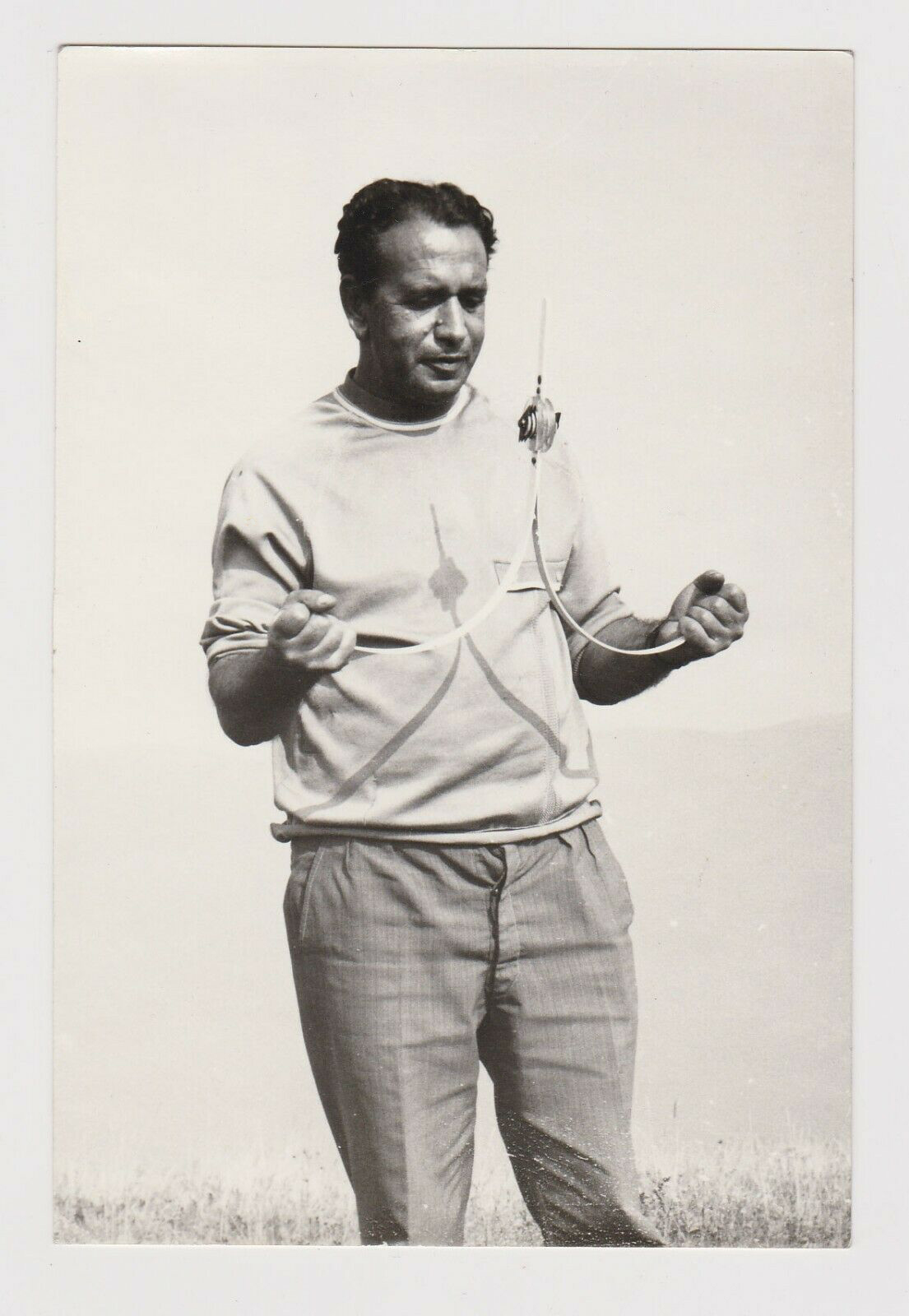

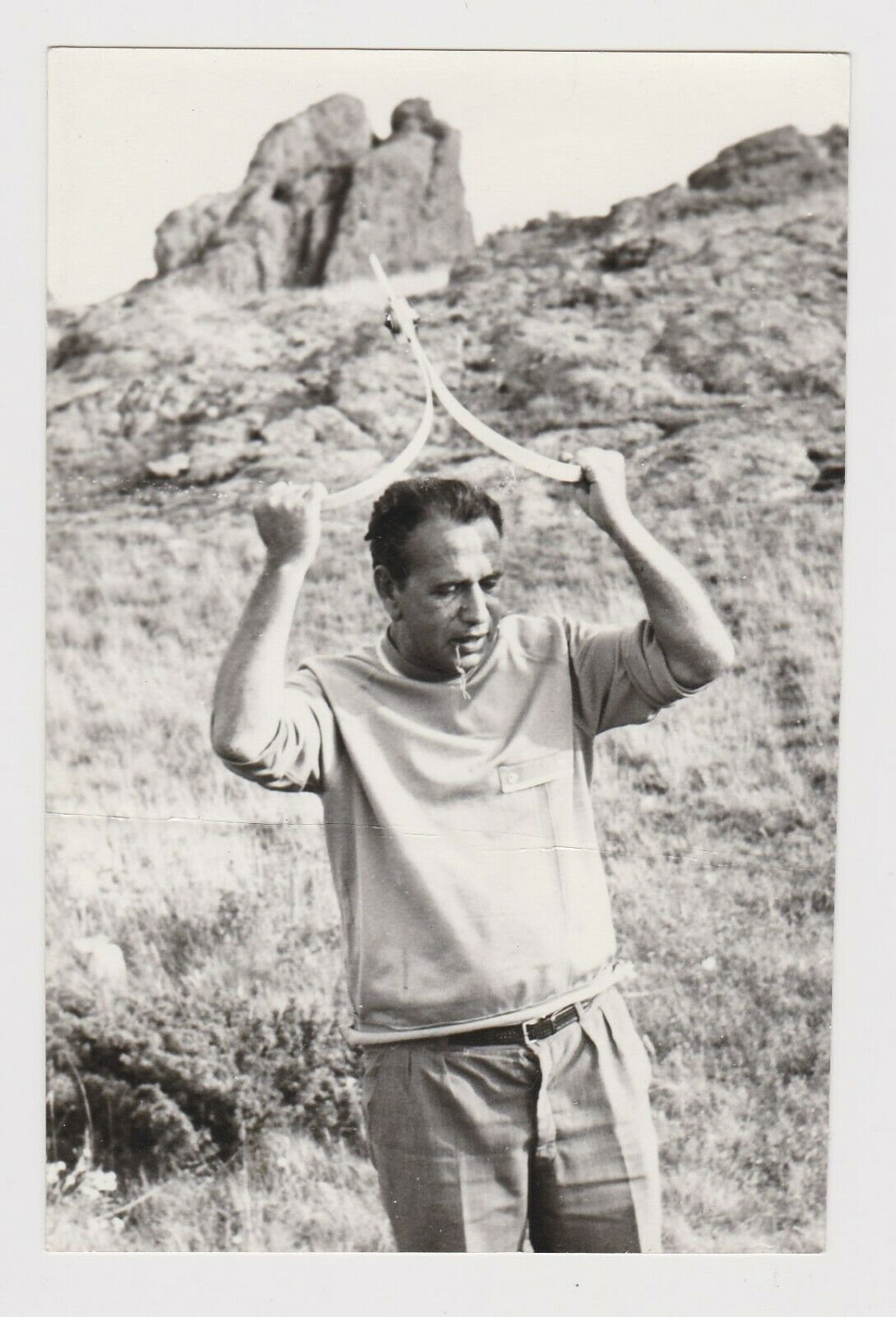
The operator is holding an unusually complex Y-rod, apparently made of plastic, with a large witness-sample device at the center-point comprised of a series of graduated disks with what look like free-spinning or adjustable directional indicators. Consulting "Dowsing Devices" by Oscar T. Branson (see below) leads me to the conclusion that this is a modern reproduction of an antique Spanish Dip Needle. The geology resembles the valley of the Rusenski Lom (a tributary of the Danube), possibly near or in the Rusenski Lom Nature Park. If you know who this dowser is, and where and when the photos were taken, please contact the web-master.
PROLOGUE: THE AMERICAN SOCIETY OF DOWSERS
The present bibliography only covers books on dowsing, water-witching, and doodlebugging. However, no bibliography on dowsing would be complete without a mention of The American Dowser Quarterly Digest.
The American Society of Dowsers (ASD) was founded in 1961, and the Quarterly Digest was its flagship offering from 1961 to 2019, when publication ceased. This invaluable resource on dowsing was published more-or-less quarterly, as its title implies, with a few double-issues along the way, and in its 59 years of existence, about 230 issues were released. Between its prim blue-and-white covers were contained thousands of amazing articles, and extracts from forthcoming books on both physical and psychic dowsing, the true backbone of American dowsing in the 20th and early 21st centuries.
The ASD also published books -- see "1963 - 1988: The Water Dowsers Manual" listed below -- but it was in the pages of the Quarterly Digest that these texts first appeared. In 2019 the ASD suspended publication of the Quarterly Digest and "went digital," which meant that only dues-paid members could access the new materiatial, effectively closing the door to new membership in the organization, because copies of the Digest are no longer passed around, handed out as gifts, or make their way to online or physical bookshops. A project was announced to digitize the complete run of the Quarterly Digest, but much work remains undone, and the outcome will be very limited in scope, as its goal is to make the back issues available to members only, and to remove 59 years of ASD texts from public accessibility.
In the meantime, individual used copies of the ASD Quarterly Digest from the 1980s through the end of the run can be found with diigent searches online and through the occult bibliophile communty. They go for anywhere from $5.00 - $12.00 per copy, depending on condition and rarity, Copies from the 1960s and 1970s are much more difficult to find and are priced accordingly. Good luck!

American Society of Dowsers [Maria Perry, ed.]. 1963 - 1988: The Water Dowsers Manual.
Danville, Vermont, The American Society of Dowsers, 1990.
200 pages. Paperback.
This is a valuable and well-edited compilation of all of the major articles about water dowsing that appeared in the American Dowser Quarterly Digest between 1963 and 1988. Dozens of excellent authors are represented, including Gordan MacLean, Verne Cameron, Bob Ater, Louis Matacia, Jack Livingston, and Paul Sevigny.The material covers the period of time when practical dowsing led the field. Within just a few years after this collection was assembled, the techniques of psychic dowsing took center stage in the American Dowser Quarterly Digest; after that, water, mineral, oil, and treasure dowsing were no longer the focus of attention in ASD publications.
Short of collecting and poring through every issue of the periodical yourself, this book will provide you with the cream of the crop of short, highly informative, and, above all, practical articles on mid-to-late 20th century American water dowsing in theory and in practice. I am grateful to the editor, Maria Perry, for assembling this definitive source book before the knowledge it contains slipped away into the past, and to the ASD for publishing it just as the organization itself was pivoting from Old-School to New-Age paradigms of dowsing.
A copy of this manual belongs in the library of every dowser.

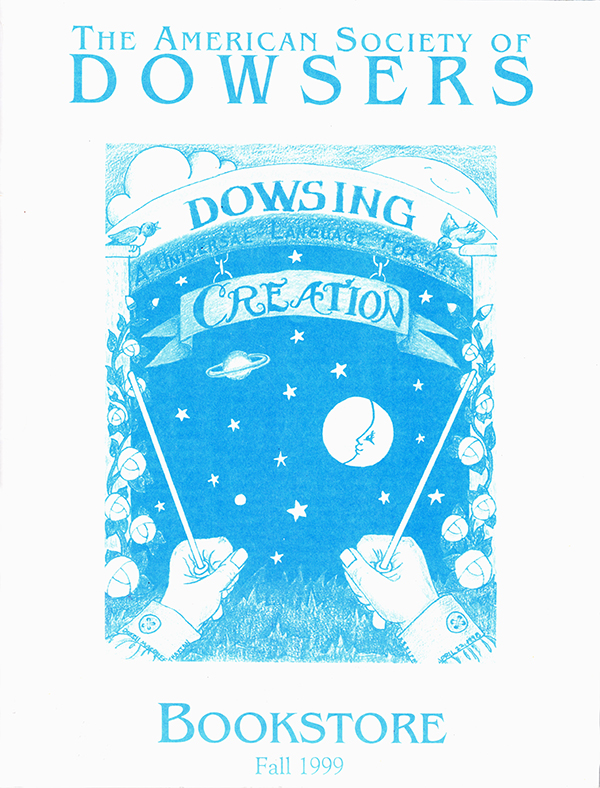
American Society of Dowsers Bookstore, Fall 1999.
Edited by Brenda Paquin, Gretchen Stein, Sherry Hevey, and Claudette Swett
Danville, Vermont, The American Society of Dowsers, 1999 .
48 pages plus wraps (mis-numbered as 49 pages), saddle-stitchedThe ASD used to operate an amazing bookstore and dowsing tool shop at the organization's headquarters in Vermont. With the coming of the internet, there was a heroic effort made to get everything online, first through a local dial-up service and then at dowsers.org -- but while that was ongoing, paper catalogues were still being issued and mailed to members. I don't know if this 1999 ASB Bookstore catalogue was the last one printed, but i have seen none later than it. A PDF versions of the 2007 catalogue can be found online.
The editorial team did a remarkable job of organizing the material in the good, old-fashioned bookstore catalogue way, with mini-reviews and annotations. Thus this catalogue is a valuable adjunct to personal bibliographical searches and tips turned in by friends and fellow-dowsers, because it shows us what books on dowsing were still in print at the end of the 20th century.
Unfortunately, as i have lamented at probably too much length elsewhere, by 1999, the ASD was turning away from dowsing and was placing its focus, emphasis, and resources on the promotion of New Age beliefs, which went far beyond dowsing, and even occulted dowsing from the the view of its members. In fact, out of 48 pages in the American Society of Dowsers Bookstore catalogue of Fall, 1999, only five pages were devoted to dowsing, and four pages were set aside for the sale of dowsing tools and locator devices such as pendulums, L-rods, Y-rods, and aurameters. The remaining 39 pages consisted of listings for books on earth energies, esotericism, metaphysics, self-esteem, feng shui, fiction, the ascended master Hilarion, life after death, past lives, the Montauk Project, psyschic development, reiki, runes, spirituality, Tesla (the man, not the automobiles), and well-being. For whatever reason, this is what the ASD embraced, as they let dowsing faded away. There is still an ASD bookstore, but the number of dowsing books is small -- and its not because dowsing is a technique whose time has passed -- it is because the ASD has taken a turn away from dowsing.
Books listed in the Fall 1999 catalogue which are not in my collection may be found here, with the brief reviews given by Paquin, Stein, Hevey, and Swett, to whom my gratitude is extended from the distance of a quarter-century.
American Society of Dowsers.[Edited by Carol Irons]. Basic Dowsing Instruction
Danville, Vermont, American Society of Dowsers, 1990
8 pages, Illustrated Pamphlet in Saddle-Stitched Paper wraps.This is a handy guide for new dowsers -- at least the first 5 pages are. The credited authors are Terry Ross II, Chris Bird, Sig Lonegren, Edward Jastram, Bud Dowden, Pauline Nobel, and Guy Hockett. They bring us short pieces on
Historical Background
Dowsing in the Present
The Pendulum
The Y-Rod
The Angle-Rod
General ConsiderationsUh-oh. No bobbers, no aurameters, no hand dowsing, no field dowsing, but, oh my gosh, those "General Considerations," two whole pages of them in tiny, tiny type! This is where the ASD of the late 20th century began to teach people to follow what i call "the orthodox inductive Mother May I? chant." You probably know it by now:
MAY I DOWSE? Is it alright for me?
CAN I? Do I have the ability?
SHOUD I? Is it alright for the client, considering all the circumstances?Unless you ask these three specific questions and get positive responses, the ASD declares: You may not. You can not. You should not.
But before you mindlessly accept their weirdly negative series of self-doubting questions, please consider this opposing philosophy, from the 1903 book "As a Man Thinketh" by James Allen: "Having conceived of his purpose, a man should mentally mark out a straight pathway to its achievement, looking neither to the right nor the left."
In other words, if your purpose is to dowse, you may, can, and should just DO IT.
PART ONE: TITLES IN ENGLISH
Alexandersson, Olaf. Living Water: Viktor Schauberger and the Secrets of Natural Energy.
translated by Kit Zweigbergk and Charles Zweigbergk.
Gateway Books, 1979
Turnstone Press, 1982
Gateway Books, Bath, UK, 1990
Gill Books, 2002
162 page, softcover
This book is available as a pdf at
https://ia902808.us.archive.org/10/items/LivingWater_823/ViktorSchauberger-LivingWater.pdfViktor Schauberger (1885-1958) was a Bavian naturalist. This book is more about earth energies and the biosphere than about dowsing per se, but it does cast light on the connection between water and life, and thus it brings forth the fundamental reasons that living beings can and do sense and follow the presence of water. For this reason it was included as a fundamental text in the 1999 ASD Bookstore Catalogue.
"By studying fish in streams and by closely observing the natural water cycle, the author was able to solve the basic problem of energy transformation. He saw that modern man, without realizing it, was destroying the earth and sabotaging his own culture by working against nature." -- ASD Bookstore Catalogue, Fall, 1999.
1. Who Was Viktor Schauberger? 17
2. New Techniques of Water Management 39
3. Schauberger's Teachings on Water 50
4. The Life and Death of a Forest 66
5. Perpetual Motion 76
6. Implosion and Biosynthesis 83
7. A Meeting With Hitler 88
8. Wartime Experiences 92
9. Biological Techniques in Agriculture 96
10. Schauberger's Criticism of Science and Society 111
11. The Final Years 116
12. Schauberger's Heritage 124
13. The Spreading Scientific Search 129

Angyal, Eva. Vital Knowledge: Holistic Health-Reference and Dowsing Manual
Sigma Publishing, 1998
100 pages, softcover"This manual is an educational, self-help tool designed to help us take responsibility for our all-around well-being. A tool to take us in the direction of holistic wellness. An oversized book that contains many pendulum charts on heavy laminated paper." -- ASD Bookstore Catalogue, Fall, 1999.
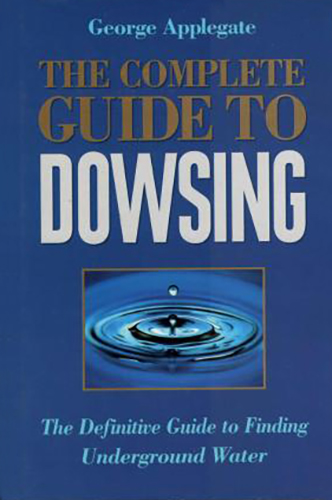
Applegate, George. The Complete Guide to Dowsing: The Definitive Guide to Finding Underground Water
Shaftesbury, Dorset, Element Books Limited, 1997.
302 pages. Hardcover. Illustrated with diagrams and Photos."A unique and modern ap-proach to the ancient art of dowsing and locating underground water. Authorita-tively and accessibly written by a leading dowser and full of practical information, this excellent guide to dowsing covers: the principles and techniques of dowsing, advanced dowsing techniques, how to use dowsing for engineering and industrial applications, understanding the impor-tance of geology and land formation, a wide ranging reference section. -- ASD Bookstore Catalogue, Fall, 1999.
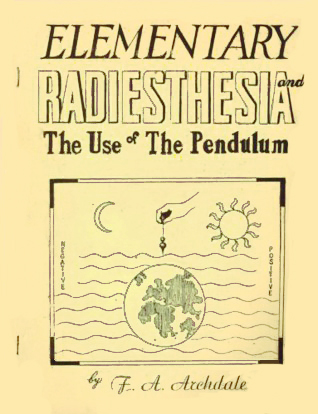
Archdale, F. A. Elementary Radiesthesia and The Use of the Pendulum
1950.
Reprinted, Third Edition, 1956.
Reprinted, Mokelumne Hill, California, Health Research, 1961.
Reprinted, Christies Beach, South Australia, Radionic and Chirotherapy Centre, 1977.
32 pages.Contents:
My Early Days in Radiesthesia;
The Pendulum,
Operator,
Sensitivity Test,
Polarity,
Samples,
Times,
Auto-suggestion,
Adjustment of the Pendulum,
Left-Handed Operators,
Radiations,
Testing Water,
Selection of Food.
Agriculture,
Testing Eggs,
Miscellaneous Experiments,
Medical,
Use of Maps and Photographs,
Teleradiesthesia.
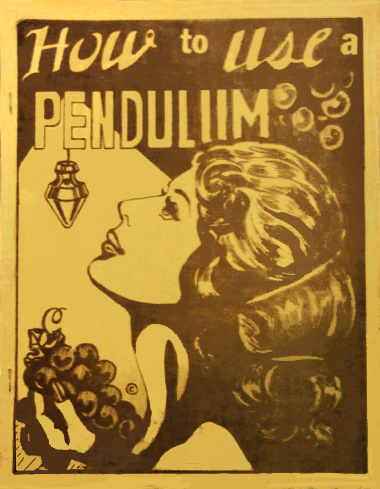
Askew, Stella [and "An Anonymous Doctor"]. How to Use a Pendulum by Stella Askew and Diagnostic Analysis with the Pendulum Compiled for Health Research by a Doctor Who Prefers to Remain Anonymous
Mokelumne Hill, California, Health Research, 1955, 1960, 1966, 1996.
Reprinted: TRI-State Press, 1993
38 pages. Illustrated.The cover only mentions Stella Askew as the author of "How To Use a Penduum," but the title page refers to two authors, and essentially lets it be known that what we are looking at is two books in one: "How to Use a Pendulum" by Stella Askew and "Diagnostic Analysis with the Pendulum," the latter "Compiled for Health Research by a Doctor Who Prefers to Remain Anonymous." This was one of the few original titles published by Health Research, which mostly reprinted metaphysical books of the late 19th and early 20th centuries. The material is solid and easy to follow, and the diagnostic portion references Old-School practitioners such as the British medical dowser Vernon D. Wethered (see below). Several editions exist, with at least two variant covers.
From the Introduction: "In the seven discussions of pendular work appearing in the following pages, there will be found considerable variation in approach and in method. Each of the writers is a successful pendulum operator and the information given will be helpful both to the beginner and experienced pendular. Three of the discussions record the experiences of individuals in America and the remaining four comprise material condensed from four books published in England. That there are many different ideas about the pendulum, about ways of operating it and about the causes of its movements, may seem surprising when the results are found to be so uniformly accurate. There seems to be general agreement, however, that although almost everyone can operate the pendulum, each individual has to work out for himself those methods which prove most successful for him personally. In presenting these discussions emphasis has therefore been placed less upon theories than upon actual pendulum operation and the interpretation of results."
Ater, Robert. Dowsing: How to Do It.
Danville, Vermont, The American Society of Dowsers.
1984.A 1980s look at the usefulness of dowsing as a technique that may allow you to locate water, minerals, and lost objects. This was a standard text offered by the American Society of Dowsers for many years, but i have never seen a copy of it.
See Bob Ater describe and demonstrate a variety of dowsing tools and explain natural hydraulics and how to use a Y-Rod on YouTube in "Dowsing Instruction Part 1": https://www.youtube.com/watch?v=-4ppYJZeVWk

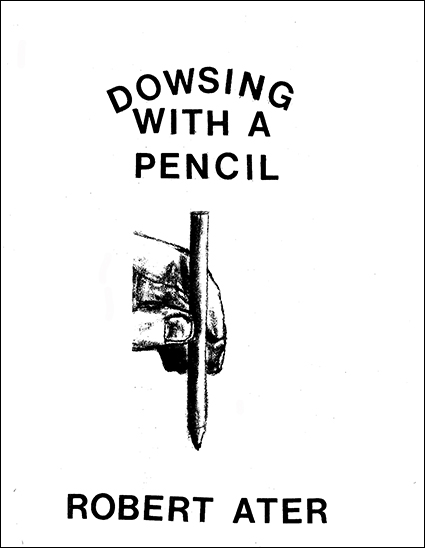
Ater, Robert. Dowsing With a Pencil.
Robert Ater, 181 Lincoln Street, Bath, Maine 04530, N.D,
{9 pages, mimeographed, with photocopied cover.Here we have a short, hand-made zine-type publication by Robert Ater, a member of the Maine Chapter of the American Society of Dowsers. Ater came up with the idea of pencil dowsing -- a cross between map dowsing with a pendulum and automatic writing during a light trance. The techniques are clearly described and should be greatly interesting to anyone to whom a light trance or channelling state is accessible. Ater gives very specific instructions, with several variations, and the whole system is intuitive and natural. Unlike map dowsing by means of running the rows or triangulating the borders of a map, pencil dowsing leaves a permanent record of the movements of the pencil while following a trail.
Ater was encouraged to publish an account of map dowsing with a pencil by Gordon MacLean, a good friend of his, and at that time the president of the ASD. An endorsement from MacLean is included in the text.
"This development of Bob Ater's is one of the most astounding facets of dowsing that I have ever seen and it deserves to be followed up by all who can handle it. At least one of our Maine members is using it successfully and is enthusiastic. Try it out and make it work for you." -- Gordon MacLean
Ater's brief treatise is undated and was not copyrighted, but it was published after the introduction of zip codes (circa 1961) and before MacLean died (in 1979). An excerpt from the book was published in the November 1978 issue of The American Dowser Quarterly (Vo. 18, No. 4) and was reprinted in the ASD's 1990 book "The Water Dowsers Manual."
I know very little about Robert (Bob) Ater, but an interesting account was given of his pencil dowsing in "Dowsing for Everyone" by Harvey Howells, published in 1979, quoting from the September 1977 issue of "The American Dowser Quarterly Digest." I include it because it relates a successful example of pencil dowsing.
"Bob told of hearing a radio report that two undergraduates were lost in the White Mountains of New Hampshire. He had no familiarity with the topography, and the radio had announced only the hikers' point of entry into the Presidential Range. With the aid of a gas station map and a pencil, he traced the route of the young men to the site where they were stranded. This information he phoned to the ranger station atop Mt. Washington. The hikers were found where he'd pinpointed them and confirmed that they had followed the course or 'channel' picked out by his pencil."
Because it was never copyrighted, the entirety of "Dowsing With a Pencil" is available as a free pdf download here: https://pdfcoffee.com/dowsing-with-a-pencil-pdf-free.html
Bailey, Richard Nigel, Eric Cambridge, and H. Denis Briggs. Dowsing and Church Archaeology
Foreword by Charles Thomas
Wimborne, England: Intercept, 1988.
xv + 192 pages. Hardcover. Illustrated.
This is an unusual book, similar in concept to the work of William, Mary, and Charles Pogson, and Tom Graves, in that it advocates the use of dowsing as a non-invasive method for establishing the outlines of buried foundations, fence-lines, graveyards, and otherwise lost archaeological structures. This topic is of particular interest in England because churches, although they are often the oldest surviving buildings in small rural towns, are regularly subjected to renovation, destruction, and rebuilding, and their accompanying cemeteries and outbuildings may have been reconfigured over the centuries. By using dowsing methods, the aim is to map what lies under the floors and on the grounds of old churches without subjecting the site or the congregation to disruptive digging, either to satisfy a desire for knowledge or as a guide to eventual selective archaeological exploration.
The authors' academic and technical credentials indicate the seriousness of their purpose in writing this book. Richard Nigel Bailey, born in 1936, was a professor of Anglo-Saxon Civilization at the University of Newcastle upon Tyne, where he specialized in Viking and Anglo-Saxon sculpture. Eric Cambridge was a Research Assistant in the Department of Archaeology at the University of Durham and participated in excavations and surveys of major medieval sites in Northern England. H. Denis Briggs was an engineer who was educated at the Rutherford College of Technology and was the head of the technical information department at the International Research and Development Company.

Baritel, Hilaire. Jacob's Rod: A Translation from The French of a Rare and Curious Work, A.D. 1693, on the Art of Finding Springs, Mines, and Minerals by Means of the Hazel Rod: To Which Is Appended Researches, With Proofs of the Existence of a More Certain and Far Higher Faculty, With Clear and Ample Instruction for Using It.
Translated from French into English, with additional text by the translator, Thos. Welton, and published in London by Thos. Welton, 1875.
Nicolas, Jean. La Verge de Jacob, ou l'Art de Trouver les Tresors les Sources, les Limites, les Metaux, les Mines, les Mineraux et Outres Cachees, par l'Usage du Baton Fourche.
Originally published in French at Lyon, 1693. as
Welton's translation reprinted as
Jacob's Rod: A 17th Century Treatise on the Ancient and Honorable Arte of Dowsing
Quareia Publishing/Goblyn Market, 2018
146 pages, Paperback
Welton's translation reprinted as
Jacob's Rod: The Art of Finding Springs, Mines, and Minerals by Means of the Hazel Rod
Fredonia Books, 2002.In this book, dowsing is called Bletonism. There are bibliographical notes elsewhere that indicate that M. Hilaire Baritel may have been a pseudonym for Jean Nicolas, noted as the author below in the non-Elngish-Language section..
The first part, written in 1693 by Baritel / Nicholas, is about water dowsing and the like. The second part, written in 1875 by the translator Thomas Welton, deals with trance dowsing and also contains one of the earliest references to map dowsing.
Barrett, Sir William and Besterman, Theodore. The Divining Rod: An Experimental and Psychological Investigation.
London, Methuen & Co., Ltd. 1926
Reprinted, New Hyde Park, N.Y., University Books, 1968.
xxiii + 336 pages, including 12 plates and 62 other illustrations. Hardcover.The experimental model of dowsing generally centers on hard targets and the search for verifiable physical substances, such as water, oil, minerals, or lost possessions. The psychological model of dowsing generally takes as its topic of interest the formation of theories related to passive or receptive dowsing for informational purposes, in which the dowsers are asking their own brains for knowledge which they are not conscious they possess.
Theodore Deodatus Nathaniel Besterman (1904-1976) was a psychical researcher, bibliographer, biographer, and translator. Born in Lod, Poland, he moved to England while still young. In 1924 he wrote his first book on psychical phenomena, "Crystal Gazing: A study in the History, Distribution and Practice of Scrying," which was followed by "The Divining Rod: An Experimental and Psychological Investigation" (1926). From 1927 to 1935 he was the investigating officer for the Society for Psychical Research. In 1938 he wrote "Water Divining: New Facts & Theories," which has its own listing.
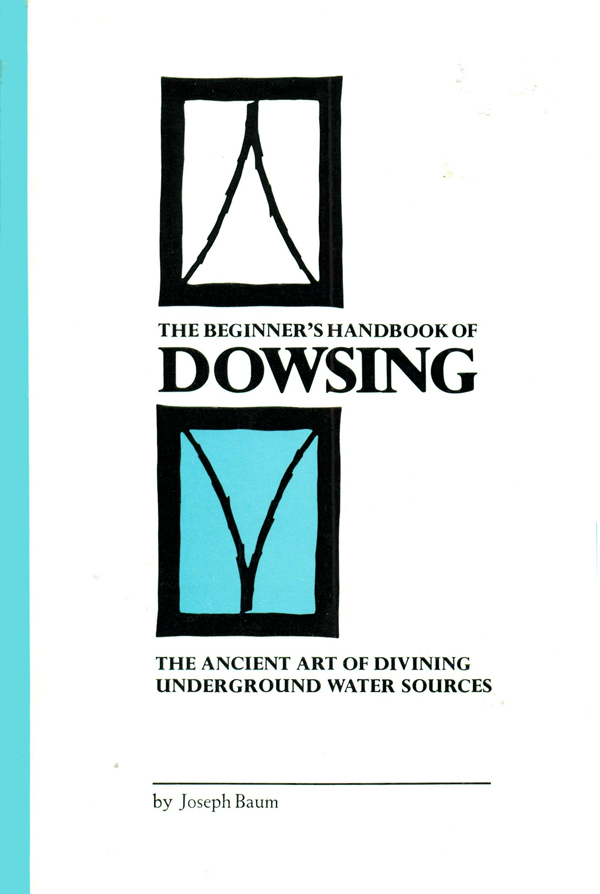
Baum, Joseph. The Beginner's Handbook of Dowsing: The Ancient Art of Divining Underground Water Sources.
New York, Crown Publishers, 1974.
32 pages. Hardcover.Publisher's blurb:
"For all who want to experience the thrill and exhilaration of finding a clear, cool, free-flowing supply of pure water on their own land, "The Beginner's Handbook of Dowsing" is the one book available today that explains this ancient skill."
"Written by an eminent dowser, illustrated with clear informative step-by-step line drawings, this concise guide covers all phases of dowsing, from its origins in the sixteenth century to its present-day uses. The author demonstrates the proper type of divining rod to use ("as simple as a forked branch or as complex as electronic gear") and details the proper way to hold the rod for best results."
"Beginning dowsers can also learn the correct way to walk with the rod, what to look for when trying to find the Point of Greatest Pull, and how to determine the depth and the flow of the underground source for water. There are even instructions on how to dig, drive, or bore your own well!"
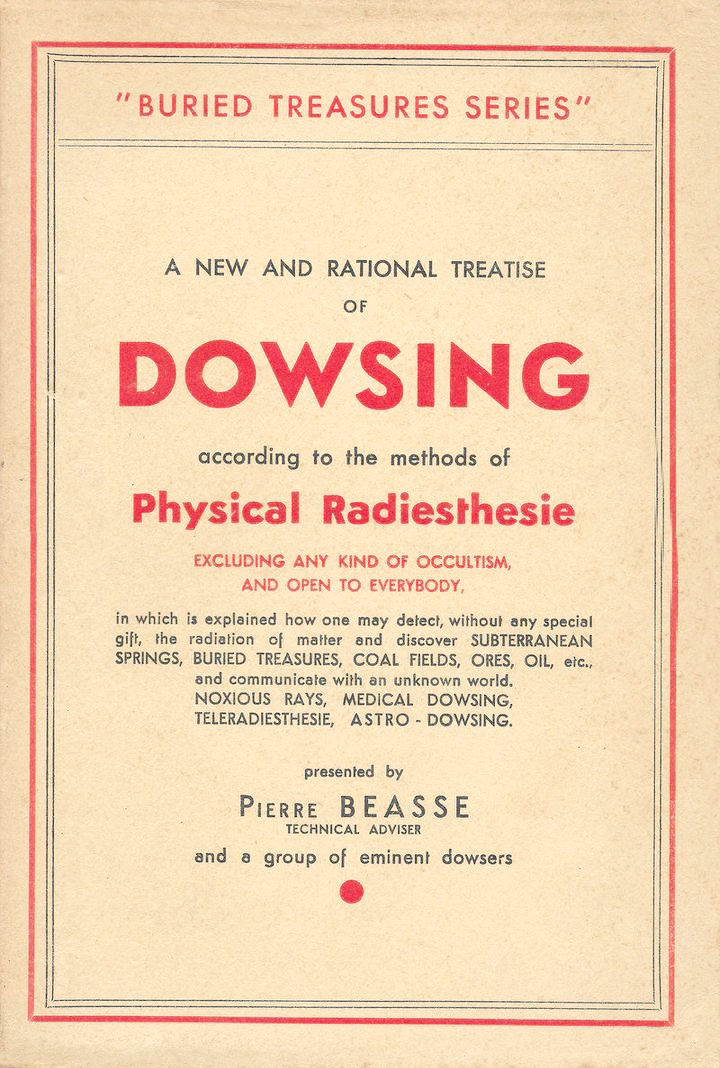
Beasse, Pierre. New and Rational Treatise of Dowsing According to the Methods of Physical Radiesthesie Excluding Any Kind of Occultism, and Open to Everybody
Nice, France, Progres Scientifique, 1941. ("Translation of the second French edition which has been considerably enlarged from the 1938 first edition.")
214 pages; 91 illustrations. Paperback.
Reprinted, Mokelumne Hill, California, Health Research, 1975. (Spiral-Bound.)
Reprinted, Hastings, United Kingdom, Society of Metaphysicians Ltd, 1986. (Paperback.)The full title presents the scope of this important work of the mid 20th century: "Buried Treasure Series. A New and Rational Treatise of Dowsing According to the Methods of Physical Radiesthesie Excluding Any Kind of Occultism, and Open to Everybody, in which is described how one may detect, without any special gift, the radiation of matter and discover subterranean springs, buried treasures, coal fields, ores, oil, etc, and communicate with an unknown world. Noxious Rays, Medical Dowsing, Teleradiesthie, Astro-Dowsing." Quite a title!
The emphasis is on the detection of various forms of subtle electrical-magnetic radiation -- and thus the "technical adviser" Pierre Beasse, and his "group of eminent dowsers" stand on the high ground of pragmatic, practical, and active Old-School dowsing, before the incursion of the New-Age method of "asking permission" to question one's own "subconscious" about "what is best."
From ad copy: "The science of dowsing is divided into three parts: Teleradiesthesie, Astro Dowsing, and Radiesthesie. All things material, dead or alive, possess and radiate certain energy force so the dowser, by concentrating on the hidden object, is able to tune into the energy of the object or element which in turn forces the dowsing rod or stick to move. Dowsing tools act as amplifiers or antennas for tuning into energy so able to detect the emission of certain substances including: water, buried treasures, subterranean springs, coal fields, ores, oil, and even people."
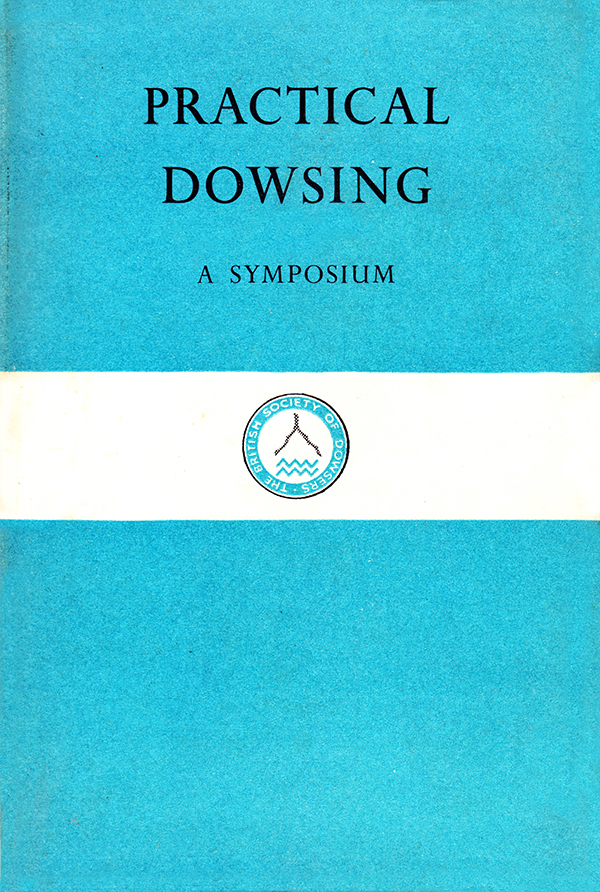
Bell, A. H. [Editor]. Practical Dowsing: A Symposium.
London: G. Bell & Sons Ltd., 1965.
viii + 198 pages. Hard Cover with Dust Jacket.At the time that this book was compiled from articles in the journal of the British Society of Dowsers, British dowsing was of great interest to engineers and military men. Colonel A. H. Bell, D.S.O., O.B.E, had first became acquainted with dowsing in 1900 when he was serving in South Africa. He founded the BSD in 1933, and many of the society’s early members were also army officers. The table of contents will tell you how good this book is, and i have marked with an asterisk (*) those authors who also published their own complete books.
Frontispiece: Captain W. H. Trinder *
Foreword: M. H. Varvill, Esq., C.M G. v
Introduction: Colonel A. H. Bell, D.S.O., O.B.E.
Dowsing in the Field: A. C. Williamson 19
Dowsing for Water: Colonel K. W. Merrylee, O.B.E., M.I.Mech.E. 36
Dowsing for Water: Lieut. Colonel C.D.A. Fenwick 50
A Successful Feat: Colonel H. Gratton, C.B.E. 62
Shallow Well Drilling in Soft Soils: Hugh Lynch 77
Dowsing and Archaeology: Major-General J. Scott-Elliot, C.B. C.B.E., D.S.O. 82 *
Tracing the Lost: W. H. Burgoyne 92
Dowsing From a Distance: Rev. H. W. Lea-Wilson, M.A.
The Neutralisation of Harmful Rays: A. D. Manning 106
Spiritual and Mental Healing: A. Noel Spong 114
Hypnotic Cures and the Relief of Pain by Touch: Eric Cuddon, M.A., B.C.L.
Close-Up Dowsing for Medical Purposes: V. D. Wethered, B.Sc. 145 *
Medical Dowsing with Rules and Discs: Major J. F. F. Blythe-Praeger 166
The Laurence Technique of Psionic Diagnosis and Treatment: Dr. A. T. Westlake, B.A.,
M.B., B.Chir., M.R.C.S., L.R.C.P. 179
Postscript: 192
Index: 195For those keeping score:
B.Chir. = Bachelor of Chiropractic Medicine
B.C.L. = Bachelor of Civil Law
B.Sc. = Bachelor of Science
C.B. = Companion of the Order of the Bath
C.B.E. = Commander of the British Empire
C.M.G. = Companion of the Most Distinguished Order of St. Michael and St. George
Dr. = Doctor; generally a medical doctor
D.S.O. = Distinguished Service Order
Esq. = Esquire, a title of courtesy often used by attorneys
L.R.C.P. = Licentiate of the Royal College of Physicians of England
M.A. = Master of Arts
M.B. = Bachelor of Medicine, Bachelor of Surgery
M.I.Mech.E. = Member of the Institution of Mechanical Engineers
M.R.C.S. = Member of the Royal College of Surgeons of England
O.B.E. = Order of the British Empire
Rev. = Reverend, a title of courtesy often used by church leaders
Bentov, Itzhak. Stalking the Wild Pendulum: On the Mechanics of Consciousness.
New York, E.P. Dutton, 1977.This is not a practical book on dowsing, but it is an interesting read, given the publication date, which falls toward the close of the practical Old-School Dowsing era, with its searches for water, oil, and lost objects, and the rise of the New Age Dowsing era, with its emphasis on psychological dowsing and exploring the consciousness of the self. In other words, the topic here is consciousness-voyaging, not locating a good aquifer or finding your lost set of keys.
Bentov, taking a scientific approach, comes down firmly on the side of dowsing as a form of self-divining. Being a pragmatist myself, i tend to think of self-divining as a form of navel-gazing for the undecided. After taking too many drugs, people often do become confused about the simple tasks of life that we all face every day -- and this popular book fueled the rising tendency to use the pendulum as a tool particularly suited for tasks such as choosing whether to cook rice or pasta, whether to paint your room yellow or white, and whether to plant corn or stay in bed and smoke a joint.
The title, by the way, is a not-very-clever homage to the famous 1962 manual on forage-cookery, Stalking the Wild Asparagus by Euell Gibbons, who knew a great pun when he saw it. Gibbons' book, originally released in 1962, had become so popular among the hippies of the late 1960s and early 1970s that even fifteen years after its original publication, "Stalking the Wild [Whatever]" books were still being released by publishers hoping to capture the attention of the psychedelic back-to-the-land generation.

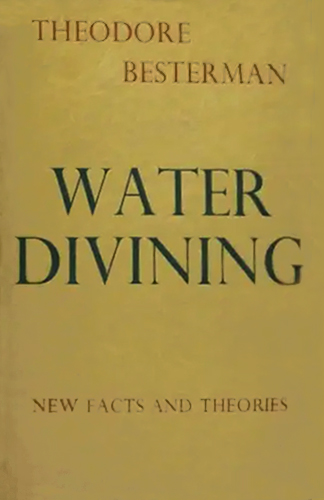
Besterman, Theodore. Water Divining: New Facts & Theories.
London: Methuen, 1938.
207 pages"Water Divining: New Facts & Theories" (1938) was the final book on psychism written by Theodore Deodatus Nathaniel Besterman (1904-1976), who had co-authored, with Sir William Barrett, "The Divining-Rod" (1926), which was long the standard work on water-divining. Besterman went on to serve in the British Royal Artillery during World War Two and subsequently worked for UNESCO. During the 1950s he lived in Switzerland and thenceforward devoted himself to translation, biography, and bibliographical writing about Voltaire. He returned to England in the late 1960s and died there in 1976.
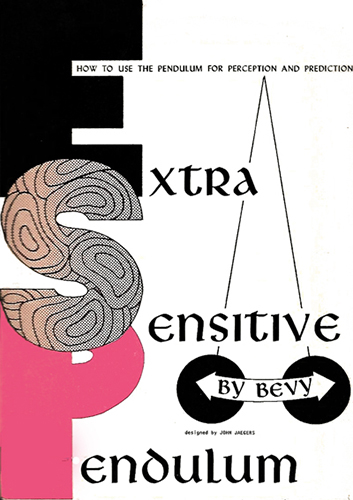
Bevy [Beverly C. Jaeger]. Extra Sensitive Pendulum: How to Use the Pendulum for Perception and Prediction.
Lumen Press, 1972.
84 pages.This book's title, "Extra Sensitive Pendulum" is noted on the cover by the big block letters E.S.P., an acronym for extra-sensory perception -- meaning a perception not gathered through the five senses of sight, sound, smell, taste, and touch. Jaeger was a well-known psychic, and in this book she presented "A Specialized Training Program" on just that -- the use of the pendulum for perception and prediction beyond the capabilities of the five senses. This book will therefore be primarily of interest to students of ESP and how it may relate to pendulum work and divination.
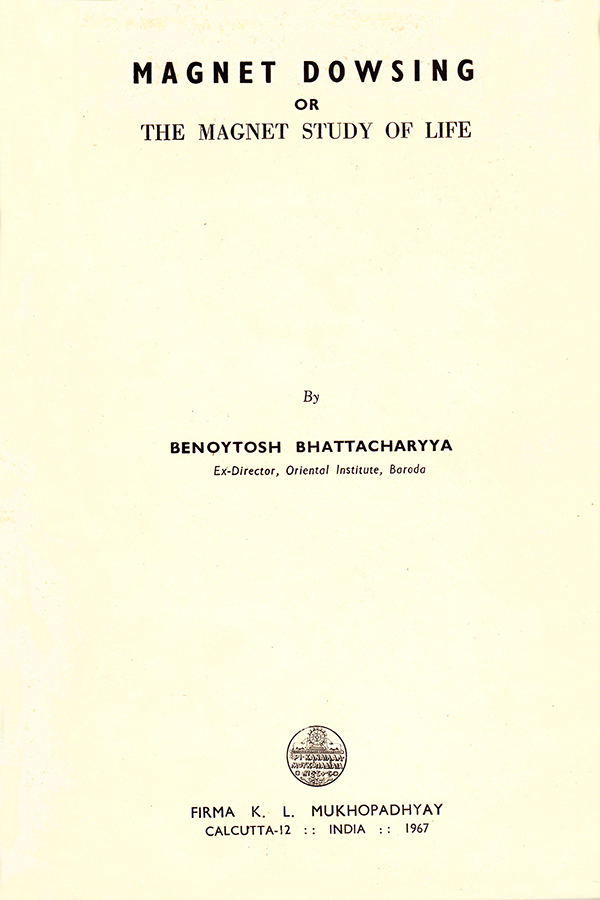
Bhattacharyya, Benoytosh. Magnet Dowsing or the Magnet Study of Life.
Edited by A.K. Bhattacharyya.
Firma K.L. Mukhopadhyay, Calcutta, 1967
152 pages. Illustrated Paperback.I got my copy of “Magnet Dowsing” by Benoytosh Bhattacharyya (1897-1964) in the posthumous edition of 1967, edited and expanded by his son A.K. Bhattacharyya. What an amazing book! I cannot recommend it too highly; it is just that great. Mr. Bhattacharyya was a contemporary of the excellent magnetic dowsers W.H. Trinder, D.W. Wethered, Marguerite Maury, and Pierre Beasse -- but to their techniques he added his own extensive knowledge of Indian Ayurveda and the Tridosha system of medicine, as well as European Homeopathy. This book is mind-blowing. It can be found in various editions online, and all i can say is that you MUST have it.
Throughout this bibliography you will find me grousing and bitching about the woo-woo practitioners of "Mother-May-I?" dowsing and the modern use of pendulum dowsing as a means to answer a myriad of trivial questions that intuition or desire can usually answer alone, without the need for psychic gifts or a special tool -- but this book -- and the companion volume, "Magnet and Magnetic Fields or Healing by Magnets" by Albert Roy Davis and A. K. Bhattacharyya (Benoytosh Bhattacharyya's son) is what the legion of "should i eat chickpeas or cabbage?" dowsers should take as their gospel. It is so, so good. Here's just one reason why i hold it in such high esteem:
Bhattacharyya teaches us how to merge the 20th century concept of the semi-circle or arc-shaped pendulum chart with the 19th century concept of magnetic healing -- a real old-school method -- and Ayurvedic medicine -- an ancient Indian system of practice -- to create a form of magnetic dowsing in which the arc is not a chart, but an assemblage of real-life objects. For example, to dowse for the right medicine, herb, or vitamin for a patient, he lays out a selection of the potentially therapeutic items in an arc, places a hand-held horseshoe magnet in his non-dominant hand to magnetize himself, lays a photo of the client on the table within the arc as a witness, suspends a magnetic pendulum (not a crystal, not a Mermet-style brass "turnip" pendulum, but an actual MAGNET) from his dominant hand, and lets the pendulum point the way to the proper choices on the arc. If you have never tried this, you have no idea of the kind of power that magnetic dowsing can manifest.
This is the only book on pendulum arc-chart dowsing you will ever need. It provides page after page of charts (Schleusser tissue remedies, colour hunger, the planets, strength of life-force, manner of death -- you name it) and each one is not only well thought out, but impeccably designed and executed in neat hand-lettering. I sincerely hope that someone -- and if i were funded, it would be me -- will produce a package in which all of the Bhattacharyya charts are digitally perfected, crisply reprinted on glossy card stock, and presented as a deck of images with instructions on the back of each card for the practitioner's use. My word to God's ear.
Bird, Christopher. The Divining Hand.
New York, E. P. Dutton, 1979.
Reprinted by Whitford Press / Schiffer Publishing, 1993.This is a very large and thorough book, containing a definitive history of dowsing from the 15th century to the 20th century, along with practical advice on how to become an effective dowser. It is certainly the best compendium of historical material under one cover and is an essential book for anyone who wants to learn all about dowsing in addition to becoming a dowser. Its only drawback is its sheer size and weight -- it is big, and it is heavy! Someone should reprint it in hardcover, so that handling it would be easier, because the large, thick, flopsy paperback (a popular style of book in 1979, when it was first published) is quite awkward. Truly a must-have book for dowsers.
Christopher Bird (1928-1996) was a former CIA agent and Vietnam veteran. With Peter Tompkins, he was the co-author of an extremely popular book on metaphysical botany, "The Secret Life of Plants" (1973). He was also the international corresponding secretary for the Americal Society of Dowsers for a number of years.
Blackburn, Gabriele. The Science and Art of the Pendulum: A Complete Course in Radiesthesia
Idylwild Books, 1984
96 pages, softcover"An ancient healing science updated with new methods and dimensions -- a practical approach to the establishment and maintenance of health." -- ASD Bookstore Catalogue, Fall, 1999.
"Here are a variety of new ways to use the pendulum in connection with healing ... Diagnosis, therapy, revitalizing" -- A Transformative Journey Magical Blend Magazine
"This is a beautifully produced book which will have instant appeal for all who are interested in achieving higher development." -- International Journal of Holistic Health and Medicine
"Expresses the knowledge she has gained in a simple manner [to]those interested in the art/science of diagnosis via the pendulum." -- Health World
Branson, Oscar T. (text) and Asch, Connie (illustrations). Dowsing Devices: A Sketchbook of Devices Used in Dowsing.
New Mexico, The Treasure Chest, 1985This is an amazingly useful and thoroughly enjoyable tour through the tools of dowsing, many drawn by the illustrator from the personal collection of the author, a trustee of the American Society of Dowsers, co-organizer and past president of the Tucson Arizona Chapter of the American Society of Dowsers, and member of the British Society of Dowsers. This book will not teach you how to dowse, but it will teach you how to identify and handle virtually any dowsing tool you come across.
Don't let the weird 1985 shiny bright orange cover scare you off, and pass with gentle indulgence over Ms. Asch's silly cartoons and the Selectric Typewriter type -- the actual TEXT CONTENT and the CLEAR ILLUSTRATIONS in this book are incredible. From it, i was immediately able to identify the unusual Y-Rod held by the Bulgarian Mystery Dowser (see above) as a Spanish (also called a Mexican) Dip Needle of 19th century design, and very likely one of the 1980s copies made by Carl Anderson of Tampa, Florida. I mean, that is how exacting and complete this book is! One could not ask for anything better, aside from a less orange cover and a good, professionally typeset reprint from the ASD.
Bull, Leroy Keet. The Art and Craft of Map Dowsing: A Workbook
Doylestown, Pennsylvania, Intuitive Energy Solutions / Minuteman Press, 2001.
29 pages.Spiral-bound.From the ASD site, 2024: "Leroy Bull is a prior president of the American Society of Dowsers (ASD), current Chair of the Water for Humanity Committee and International Coordinator of ASD, and was a long-term ASD trustee. He has a Bachelor of Science degree in Animal Husbandry and a Master of Science degree in Food Technology. He has successfully dowsed at least thirty-one hundred water wells. His additional dowsing jobs include four-thousand-plus earth energies projects, thousands of map dowsings and teachings, vein diversions, mineral dowsing, lost people/pets/items and assorted specialty requests. He has been featured in the New York Times newspaper and in Smithsonian Magazine, as well as in local newspapers."
The ASD has uploaded a free 2020 workshop on map dowsing and remote viewing by Leroy Bull at https://www.youtube.com/watch?v=XDlnWjWqBFU
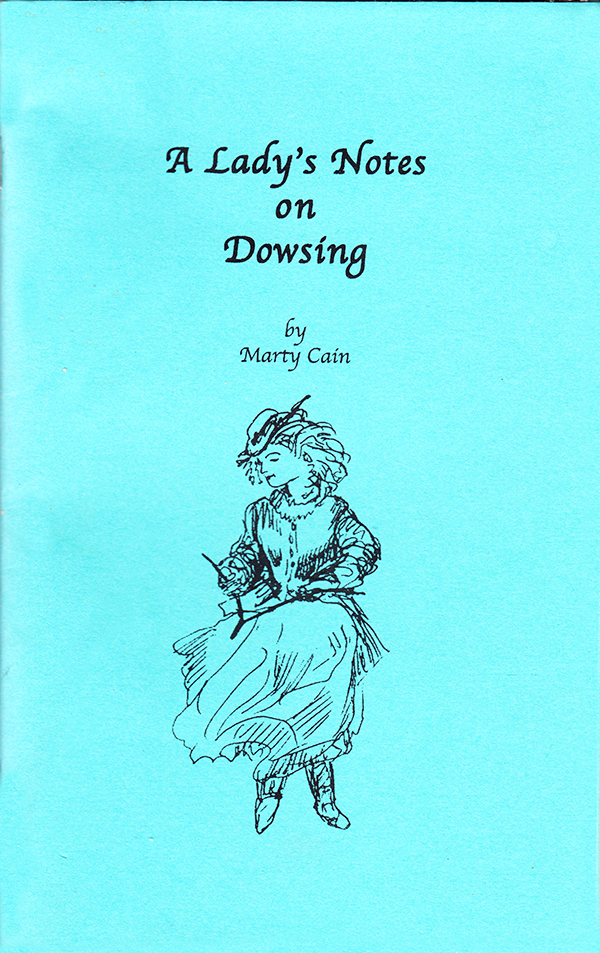
Cain, Marty. A Lady's Notes on Dowsing.
Newport, New Hampshire, Park Street Studio
Revised Edition, 2004 (I have never seen a copy of the first edition
60 pages, Illustrated, Saddle-Stitched in Paper wraps.The turquoise blue wrapper, stapled binding, and coy title might as first glance seem to indicate that this is a light, fluffy pamphlet on the author's personal experiences, but it is actually well laid-out, filled with illustrations by the author, and extremely useful as an introduction to the subject of dowsing with a Y-rod, L-rods, pendulum, bibber, and aurameter. It contains an excellent dictionary of terms and a good, basic reading list that includes titles also found in the 1999 ASD Bookstore Catalogue listed above. It is fully typeset and really looks a lot better inside than the cheap printing job would lead you to expect. I picked up a copy from the ASD while they still had copies in stock, and my first thought was, "Were this book to be printed today, it would be a square-bound paperback with a glossy full-colour cover -- and it is far better than most of those, to tell the truth."
Marty Cain subscribes to the electro-magnetic theory of dowsing, as do i, although we do differ strongly on her instructing learners to use the horrid "May i? Can i? Should i?" induction litany that became ASD canon during the 1990s -- but i would still recommend this short book for its in-depth coverage of field dowsing, water-witching, distance dowsing, medical dowsing, and much, much more. If you happen to find a copy, do pick it up. I think you'll like it.
Cameron, Verne L. The Cameron Aurameter.
Talk of the Times Press, San Diego, California, 1953.Verne L. Cameron (August 14, 1896 - November 11, 1970) was an American dowser, best known for his development of the Cameron Aurameter, a spring-loaded variation on the L-rod doodlebug device. Cameron began dowsing in 1926, when he was about 30 years old. By 1930 he had worked out the first version of the Aurameter, then known as the Water Compass.
According to Oscar T. Branson (see above), Cameron crafted many more dowsing devises, and perfected the Water Compass around 1950. His colleague Max Freedom Long was the one who first use it to dowse the energetic edges of objects and people, and who gave it the name Aurameter. In any case, it is a remarkable tool, and this book is Cameron's own introduction to its use.
According to Bill Cox, this booklet was Cameron's edited version of the article on the Aurameter that was written and published one year earlier by Meade Layne and Riley H. Crabb of the Borderland Sciences Research Foundation (which see). Cox later adapted Cameron's text, as well as adding the Layne and Crabb material, and much more of his own devising, into "The Original Cameron Aurameter Book" in 1997 (which see).
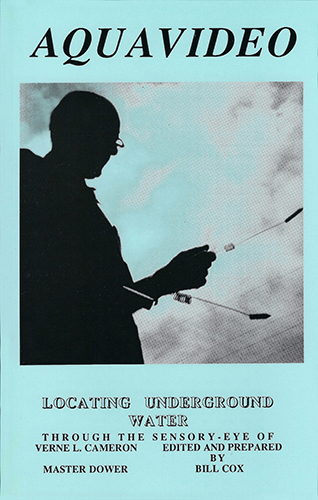
Cameron, Verne L. Aquavideo: Locating Underground Water. Edited and prepared by Bill Cox
Santa Barbara, California, El Cariso, 1970.
116 pages. Paperback.
Reprinted as
Aquavideo: Locating Underground Water Through The Sensory-Eye of Verne L. Cameron, Master Dowser
Life Understanding Foundation, 1978.
116 pages. Paperback.This is one of a trio of books by the author that cover the basics of practical dowsing for water and oil. Like the others, it was posthumously edited and published by Cameron's student and colleague Bill Cox.
Cameron was considered one of the great dowsing masters of modern times, and this book on water dowsing reveals his secret methods to locate hidden sources of water, underground ojos, interconnecting circles, ovals, and rectangular fissures, geysers, cold springs, ascending primary waters, mineral springs, and hot springs. Also covered is material on how to detect sub-surface obstructions, dikes, angular rifts and water-bearing earthquake faults.
Tools described include the wand or rod, forked-switch, pendulum, water compass, Cameron Aurameter, the "witness," and a wide variety of water-locating doodlebugs.
And, in addition to all of this, Cameron also explains his theories on the relationship between Dowsing and Radiesthesia; the nature of so-called "devil rings" and the problem of noxious earth rays.
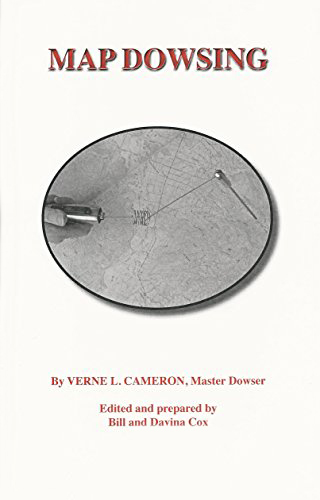
Cameron, Verne L. Map Dowsing. (The Dowser's Handbook Series No. 1)
Ink-drawing cover edition:
Edited and Prepared by Bill Cox and illustrated by Georgiana Teeple.
Santa Barbara, California, El Cariso, 1971.
Photo cover edition:
Edited and Prepared by Bill Cox and Davina Cox.
Life Understanding Foundation, 1971.In this posthumously-published book, edited by Bill Cox in two different editions, we learn the map dowsing techniques of Verne Cameron, one of the mid 20th century's best-known practical dowsers. This book explains the fundamentals of map dowsing, a method which soon came to be considered almost as useful as field dowsing, and is often preferred because it is less time-consuming than walking a field and can be performed at a distance.
Verne Cameron was a down-to-earth dowser with a remarkable success rate who invented some amazing new types of dowsing tools, but it is my belief that he would be little known today were it not for the dedicated efforts of his early colleagues Meade Layne and Riley H. Crabb of the Borderland Sciences Research Foundation, and his students Bill Cox, Georgiana Teeple, and Davina Cox, who collected and edited his papers and saw to their posthumous publication.
It is primarily through their publishing efforts -- first as small illustrated pamphlets and later as photo-illustrated books with editorial side-notes -- that Cameron's work in the discovery of water and oil, and his techniques of field and map dowsing have been kept in print for 50 years, and the Cameron Aurameter is still manufactured for sale.

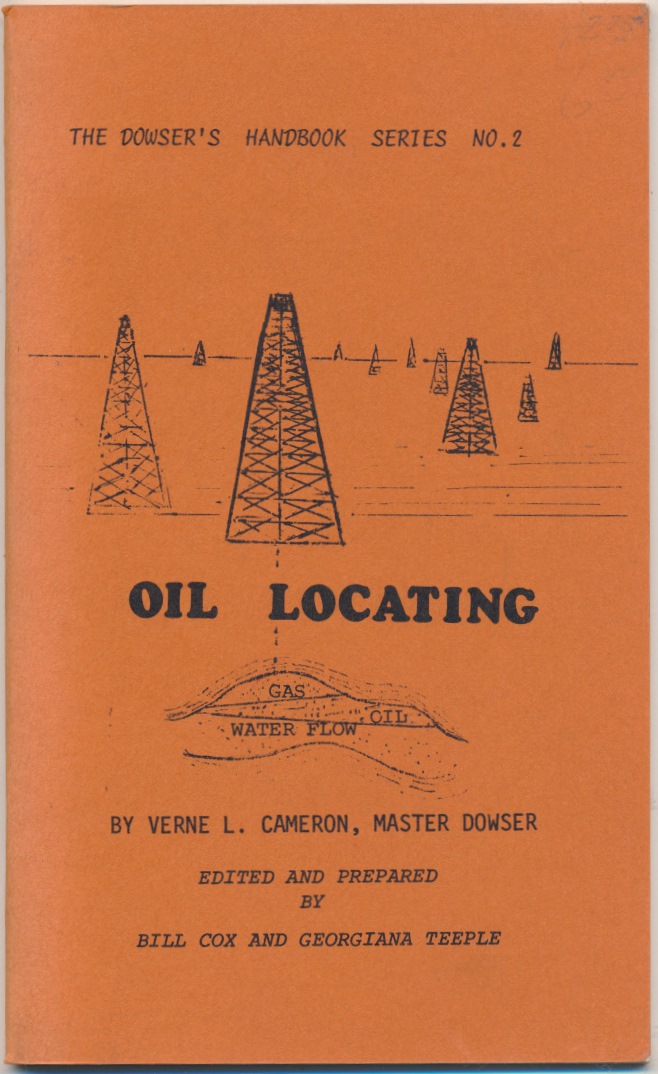
Cameron, Verne L. Oil Locating (The Dowser's Handbook Series No. 2)
Edited by Bill Cox and Georgiana Teeple; illustrated by Teeple.
Santa Barbara, California, El Cariso, 1971.
35 pages. Paperback.
Reprinted in hardcover by Life Understanding Foundation, 1997.This posthumously-published book is one of a trio of titles by the author that cover the basics of practical dowsing. In this book, Cameron describes his invention, sometime after 1935, of a rotating or gyrating Petroleometer device for oil locating, and also explains his scientific theory of human sub-awareness of electrical charges. His hypothesis is that this otherwise unnoticed electrical sub-awareness is magnified to visibility by a dowsing tool such as a pendulum, bobber, wand, Y-rod, L-rods, or spring-loaded Aurameter or Petroleometer.
Cameron did not originate the theory that dowsing tools amplify electro-magnetic anomalies and resonances to a perceptual threshold, but his great stature among American dowsers was such that although the electro-magnetic theory has so far neither been proven nor disproven, his endorsement gained it many adherents among practical dowsers.
Chambers, Howard V. Dowsing, Water Witches and Divining Rods for the Millions.
(For the Millions Series)
Los Angeles, Sherbourne Press, 1969.
156 pages.Publisher's blurb: "This book tells the why and wherefores of dowsing, for water as well as for metals. It discusses the lure of the divining rod, how the reader may make one, how the reader may see if he, too, has the Power, the strange and provacative Seventh Sense."
Howard V. Chambers was not so much a dowser as a professional author on paranormal topics. His other titles include "An Occult Dictionary for the Millions: From Aaron to Zugarramurdii" (1966), "UFOs For the Millions" (1967), "Phrenology for the Millions" (1968), and "The Facts on the Flying Saucer Controversy" (1968).
Collins, Susan. Water Wells: What a Dowser Needs to Know.
Susan Collins, 2022
64 pages, PaperbackPublisher's Blurb:"Anyone with desire and patience can learn to dowse water wells by focusing their mind and listening to their body. This book will teach you what you need to know about the Water Cycle, wells, working with drillers and dowsing so that you can successfully find the location, depth and volume of reliable sources of good water for homes, farms and businesses."
Contents:
Find Location, Depth, and Volume
The Water and Groundwater Cycle
Water well site assessment
Dowsing tools and Protocols
Well development and Remediation
Regulations
Map dowsing and remote sensing
Stream diversionSusan Collins is a Professional Dowser, Dowsing Teacher, and Personal Management Consultant. She is a Past President and Dowser of the Year of the Canadian Society of Dowsers This book presents the techniques Susan developed while dowsing hundreds of wells. It is apparently also the only book she has written on Traditional Dowsing.
The rest of the books in her nine-volume series are all concerned with different aspects of New Age thought, UFOs, paranormal phenomena, Feng Shui, bio-feedback, and personal well-being. I list them here for the sake of convenience but will not be adding them to my library unless they drop into my lap. All but one were published in 2022.
The Complete Guide to Dowsing Series by Susan Joan Collins:
Get Healthy with Dowsing: Physical Mental Emotional Spiritual Energetic
180 pages, Paperback
Susan Collins, 2020Get Happy with Dowsing: Change Unhealthy Patterns
80 pages, Paperback
Susan Collins, 2022Bridge Matter and Spirit with Dowsing: A practical guide to bring balance to your life
180 pages, Paperback
Susan Collins, 2022Dowsing That Works: Use A Protocol to Get Results
68 pages, Paperback
Susan Collins, 2022Dowsing Triage: Find and Fix Energy Problems
94 pages, Paperback
Susan Collins, 2022Dowsing for Feng Shui and Space Clearing
76 pages, Paperback
Susan Collins, 2022Meet Alien Energy with Dowsing
90 pages, Paperback
Susan Collins, 2022Meet Orbs with Dowsing
82 pages, Paperback
Susan Collins, 2022Water Wells -- What a Dowser Needs to Know
Susan Collins, 2022
64 pages, Paperback
Cooper-Hunt, C. L. Radiesthetic Analysis
1955.
Reprinted, Mokelumne Hill, California, Health Research, 1996.
40 pages.
Conway, Deanna J. A Little Book of Pendulum Magic
Berkeley, California, Crossing Press, 2001.
176 pages. Paperback, illustrated.If you are interested in New-Age dowsing of past lives, karma, and reincarnation, this will be right up your alley. It contains a total of 60 pages of simplistic art -- drawings of a straight line, a clockwise circle, a counterclockwise circle, and side-to-side movements, at the rate of one illo per page -- plus 40 half-circle pendulum charts, including 7 Gemstones Charts, 6 Animal Allies or Totems Charts, 2 Past Life Dates Charts, 2 Past Life Location Periods Charts, and, of course, the all-important Inaccuracy Cause Chart. I am not pleased with the waste of paper.
If you want a deep, complete, and wide-ranging book of pendulum charts, with full instructions on how to use them, chose "Magnet Dowsing or the Magnet Study of Life" by Benoytosh Bhattacharyya instead.
Copen, Bruce. The Practical Pendulum
1974.
Cox, Bill [Ed.]. The Original Cameron Aurameter Book: Dowsing Auras, Invisible Energies, and Thoughtforms.
Life Understanding Foundation, 1997.
74 pages. Paperback.This is a revised and expanded edition of "The Cameron Aurameter" by Meade Layne and Riley H. Crabb, first published in 1952 (which see) and then edited by Verne Cameron (which see). It is beautifully laid out and typeset and contains some lovely introductory material by Cox, including photos of Cameron, Layne, Crabb, and others in Cameron's circle, such as Max Freedom Long and Mark Probert, with simple biographical details that place their life-work in context.
I cannot praise this book enough, because it brings together, in one place, some of the formative thinking that led to Cameron's great reputation as a dowser, and also presents modern dowsers with convenient access to Layne's and Crabb's mid 20th century contributions to the field. Highly recommended.
Cox is far more than a student of Cameron, and in his long and storied career he has written and published many books of his own, all of them worth reading. In 2010 he uploaded a short instructional video about the Cameron Aurameter to YouTube, an excerpt from his three-hour workshop "Discover Dowsing with Bill Cox, professional Locator." If you are interested in this tool and want to see Cox at his best as he demonstrates the wide range of motions of which the Aurameter is capable, check it out at https://www.youtube.com/watch?v=nLWfJsbz_HE -- and to purchase the full-length video, and many of his books, go to the Bill Cox web site at http://www.dowsing.com and have a look around.

Cox, Bill. The Cameron Aurameter in Action.
Santa Barbara, California, Life Understanding Foundation, 1982.
also published as
The Original Cameron Aurameter in Action.This book ostensibly deals with the Cameron Aurameter, invented by Verne L. Cameron (1896 - 1970), which had a great impact on mid-20th century practical and medical dowsing. As explained in the text, the Aurameter, which is highly sensitive to the slightest motion of the hand, is particularly useful for measuring the edges or borders of energetic fields, whether human auras or underground streams. (See also the books by Cameron and by Meade Layne and Riley H. Crabb.)
Bill Cox was the posthumous editor of the works of Verne Cameron, and by this period in his life he seems to have taken his interest in dowsing down some very quirky byways. There are photos of Cameron locating human auras, with drawings of the detail of the human aura and how far it extends from the physical body, but what follows is a Forteana grab-bag:
We get biographies of Cameron and Cox, techniques for how to see and feel auras, a chapter called "The Circle of Violence" which describes techniques for reducing violence, far-ranging linkages to Nikola Tesla's device for photographing thought, and then in short order we are introduced to telephathic dowsing, map dowsing, thoughtography, imaging, chakra auras, and landform geomancy, plus a dowsing travelogue that includes pictures taken in India, Egypt, Stonehenge, Mount Calvary, Palenque, and Samaipata, "Brazil's zone of Mystery." It's all a bit much for me, and comes across more of a personal scrapbook than a serious book on dowsing.


Cox, Bill. The Magical Properties of Copper and Gold
Santa Barbara, California, Life Understanding Foundation, 1989
PaperbackI have never seen this book, and so far i have only found its title in a list of pamphlets and books by Bill Cox. If you have a copy for sale, please contact me.
Cox, Bill. The Psychology of Treasure Dowsing.
Santa Barbara, California, Life Understanding Foundation, 1989, 1997
92 pagesAs Cox explains, "When all efforts to locate the elusive hoard have failed, Treasure Hunters often turn to Dowsers for Help..."
This book, like several others by Cox, pays homage to his teacher, Verne L. Cameron, perhaps the greatest American dowser of the 20th century. It contains what Cox describes as "scenerios and unexpected challenges faced by Bill and the late Verne L. Cameron, after accepting Dowsing assignments in search of buried, sunken, lost, or hidden fortunes, including valuable ores."
Cameron's influence on treasure hunters, especially through his book "Map Dowsing" (see above under Cameron's entry), has never been surpassed. He died in 1970, willing his literary estate to Bill Cox, and although this book came out in 1989, a full 17 years after Cameron's death, it is pure vintage Cameron-and-Cox gold.
This is not one of your learn-how-to-dowse books, although it is filled with valuable ideas and practical tips. Rather, i consider it more of a scrap book than a coherent text, as it consists of short articles on various dowsing topics, literally ranging all over the map, from dowsing for treasure to dowsing in foreign lands, strung together by Cox's charming writing style.
Cox, Bill. Techniques of Pendulum Dowsing.
Santa Barbara, California, Life Understanding Foundation, 1977.
38 pages, Saddle-Stitched.Bill Cox has been much more than a disciple of Verne L. Cameron -- his own books are filled with a lifetime of practical knowledge and generously-shared tips and techniques. "Techniques of Pendulum Dowsing" covers how to locate Underground Water, Springs, Mines, and Oil; how to find Missing Persons, Pets, and Wild Game; how to find and date Ruins and Buried Artifacts; and how to test Soil and Planting Areas and the Purity and Quality of Food and Liquids. At 38 pages, this is more of a pamphlet than a book, but if pendulum dowsing attracts you, you will want to know what Bill Cox has to teach.
CONTENTS
Instructions 3
Dowsing and Word Meanings 4
The Pendulum 7
A Dowsing History 8
Alimentary Dowsing 9
Dowsing Fact or Fiction? 10
How Dowsing Works 10
Radiesthesia - Telepathy 12
Mediatorship and Mediumship 13
Types of Pendulums 14
Beginning 15
Holding your Pendulum 16
Techniques 17
Dowsing Pyramid Rays 18
Establishing Your Code 21
The "May Be" Response 23
The Number Series 24
The Alphabet Series 25
Finding Direction 26
Body Antenna, Directional Method 29
On-Site Locating 30
Depthing - The Bishop's Rule 31
Dowsing Photographs 32
The Witness and the Sample 33
Map Dowsing 34
Self-Tuning 35
Discover Dowsing 36
Creating a Thought Cone 38
Convention or Code 38

Cox, Bill. Techniques of Swing-Rod Dowsing.
Santa Barbara, California, Life Understanding Foundation, 1977.
Santa Monica, California, Forces, 1977
38 pages, Saddle-Stitched.Swing-Rod Dowsing was a term that Bill Cox devised to cover all forms of angle-rods and L-Rods, used both singly and in pairs. In this short pamphlet, Cox describes how "dowsers, with the aid of their subconscious mind and a suitable device, can gain information beyond the logical reasoning mind."
CONTENTS
Instruction
Definition of Dowsing
Swing-Rod Dowsing Terms
Uses for Dowsing Rods
The Dowsing Code
Establishing your Number Code
The Alphabet Code
The Mind as Tuner
The Gyrating Rod
The Beginning Step
Positions
Body-Arms Antenna Method
Finding Directions
Dowsing The Field
Depthing and the Bishop's Rule
Alimentary Dowsing
The Witness and Sample
Dowsing the Pyramid

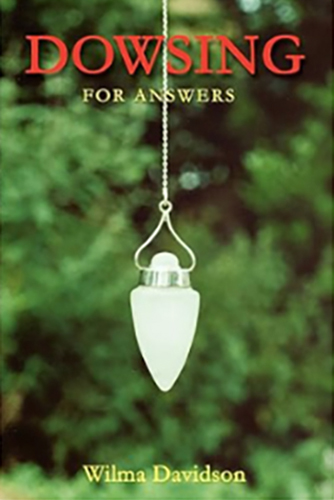
Davidson, Wilma. Dowsing for Answers.
Green Magic. 2008
270 pages. Paperback.From the publisher's description of this New Age style book on soft-target pendulum dowsing to answer questions about life and current conditions:
"Dowsing for Answers opens up a whole new world of dowsing. As well as teaching you the basics of how to dowse, the author demonstrates how you can now find answers to questions uppermost on your mind. You will learn how to find the foods that suit you best, what you may be allergic to and how to improve your health with suitable remedies."
"Wilma Davidson is an alternative health professional, Reiki master, a medium and dowsing expert. She is a member of The National Federation of Spiritual Healers and lives in the UK."
Davidson, Wilma. Dowsing for Cures: An A-Z Directory.
Green Magic. 2008
280 pages. Paperback.This book may suit some and may seem to have run off the rails to others. I count myself among the latter. Here are two enthusiastic, but not extremely literate reviews:
"Dowsing for Cures is a must in every home as this book is crammed full of valuable information about a wide range of illnesses, possible cures and treatments including rain forest medicines and minerals. Here is a book to treasure as you will quickly come to depend on it as it will become your first port of call when illness hits a member of the family. In each page you will find simple explanations to enable you to diagnose illness and find the most beneficial remedies to reduce symptoms. This book contains basic lessons on dowsing to enable you to become confident when using the pendulum. Although the book is written as an A-Z for dowsers, those who do not dowse will also find the information on illnesses absolutely invaluable as most health problems are covered include information on infertility, impotence, chemicals in the blood, depression, heart problems, schizophrenia, sleep problems and cancer. "Dowsing for Cures" is filling a great gap in the market as it teaches you how to treat illnesses using natural medicine."
"As well as her knowledge of earth energies, Wilma is a metaphysician who has twenty years experience as a spiritual healer and is a member of the National Federation of Spiritual Healers and a Reiki Master. She has studied infertility and has helped many couples to resolve this problem, she also does psychic surgery and heals sick animals. This amazing woman has used rainforest medicines and minerals for many years in her healing work with outstanding results, which has prompted her to write "Dowsing for Cures" to teach readers the benefits of natural medicine and the use of the pendulum to diagnose illness and find the right medication. In her book "Dowsing for Cures" she brings warmth and compassion to the subject of illness by offering simple treatments and practical advice which is natural and free."
Used copies are inexpensive but somehow i just couldn't rouse the interest to purchase it.

Davies, Rodney. Dowsing
UK, The Aquarian Press, 1991.
Davis, Albert Roy and A.K. Bhattacharyya. Magnet and Magnetic Field or Healing by Magnet
Calcutta, Firma K.L. Mukhopadhyay, 1970
165 pages, illustrated, Paperback.First, this is not a book about the history of dowsing, the techniques of dowsing, or why dowsing may change your life. It is a book about bio-magnetics. But -- and this is where it gets very interesting -- the co-author of "Magnet and Magnetic Field" is A.K. Bhattacharyya, the son and posthumous editor of Benoytosh Bhattacharyya, whose book "Magnet Dowsing or the Magnet Study of Life" is one of the most important books on the electro-magnetic theory of dowsing ever written, and the best popularizer of pendulum chart dowsing for medical health and healing.
The Bhattacharyyas take a scientific view of dowsing, and base their understanding of its efficacy on the basis that electro-magnetic currents are perceptible to many, if not all, living beings, including plants, mollusks, insects, fish, amphibians, reptiles, birds, and mammals. The elder Bhattacharyya's use of magnetic pendulums to dowse for both disease diagnosis and effective healing treatments is grounded in science and spirituality, and here the younger Bhattacharyya, in collaboration with the more academic Davis, provide a survey of the many then-recent studies on the evidence for magnetic perception in many species and the effects of magnetism on all manner of living beings. The use of magnets for dowsing and the use of magnets in the disgnosis and treatment of disease makes this an interesting companion to the more spiritual "Magnet Dowsing." The two go together like ... well, like a fond father and son.

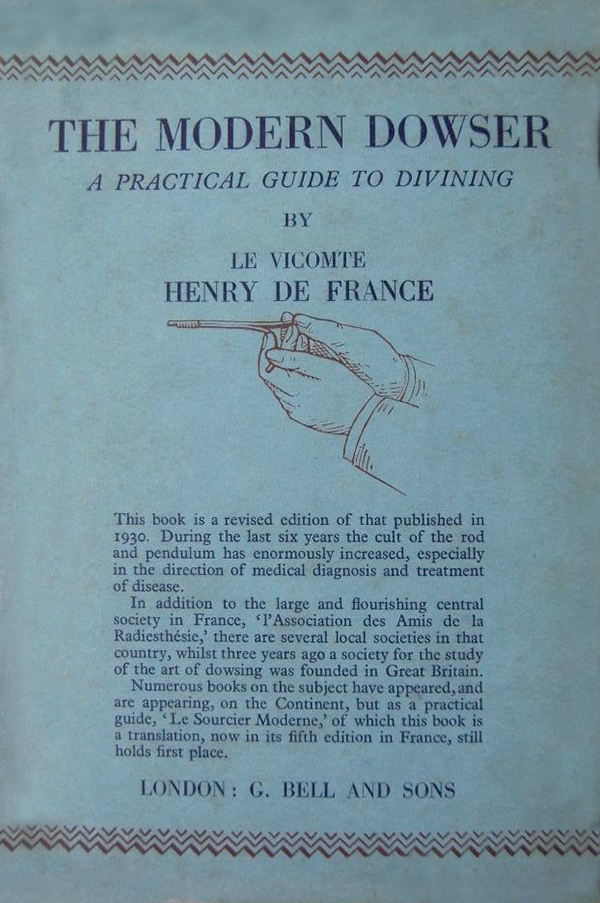
De France, Henry. The Modern Dowser: A Guide to the Use of the Divining Rod and Pendulum.
Translated by A. H. Bell
London, G. Bell and Sons Ltd., 1930.
The Modern Dowser: A Practical Guide to Divining.
Revised edition, London, G. Bell and Sons Ltd., 1936
Hardcover with Dust JacketPublisher's cover blurb:
"This book is a revised edition of that published in 1930. During the last six years the cult of the rof and pendulum has enormously increased, especially in the direction of medical diagnosis and treatment of disease.
In addition to the large and flourishing central sociey in France, 'l'Association des Amis de la Radiesthésie,' there are several local societies in the country, whilst three years ago a society for the study of the art of dowsing was founded in Great Britain.
Numerous books on the subject have appeared, and are appearing, on the Continent, but as a practical guide, 'Le Sourcier Moderne,' of which this book is a translation, now in its fifth edition in France, still holds first place."
Includes detailed instructive chapters on dowsing for water, minerals, rocks, vegetables, trees, biological conditions, and medicines.
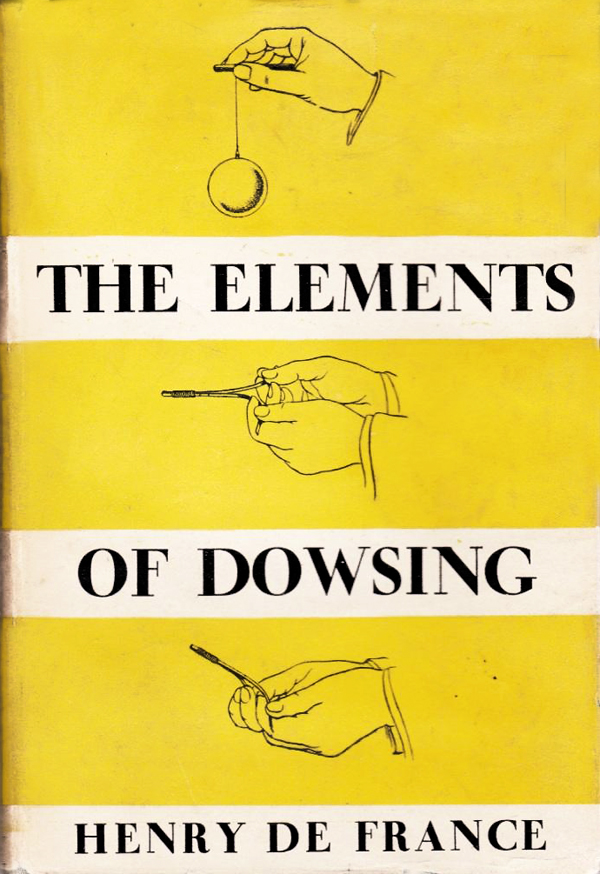
De France, Henry. The Elements of Dowsing.
London, G. Bell and Sons Ltd., 1948.
84 pages. Hardcover with Dust Jacket.Here is a 1953 publisher's advertisement for this brief book, in which the author is referred to as "The late Viscomte Henry de France," plus a comment from the Cape Argus newspaper:
"The author of this book gives in the most straightforward language an introduction to radiesthesia and tele-radiesthesia, faculties most people posses to a greater or less degree. Here is a subject to which an increasingly wide amount of investigation has been devoted over the last thirty years and of which the author is a recognized authority." [The publisher].
"Should be of profound interest to all students of this fascinating and mysterious branch of knowledge." -- Cape Argus
Henry De France was a friend to, and had an influence upon A. H. Bell, the founder of the British Society of Dowsers. He was highly respected by the English dowsing community, and was often cited by them in their works.
Deaver, Korra. Rock Crystal: The Magic Stone.
Samuel Weiser 1985. Revised edition 1986.
72 pages. Paperback.This is not a book about dowsing per se; rather it is an account of the wonderful properties of clear quartz rock, commonly known as rock crystal. It is, as the page-count makes clear, a slender volume, but it does contain two chapters of note, one on crystal gazing with quartz and the other on the use of quartz crystal in pendulum dowsing. Published in 1985, it is an early representative of the passive, informational, and subjective school of dowsing.
I include "Rock Crystal: The Magic Stone" among the more traditional dowsing volumes collected here because the author attributes the movement of the quartz crystal pendulum to "the subconscious" and the third chapter of this book is titled "Programming the Pendulum."
Theories of the pendulum's connection to the subconscious mind of the operator were not new in 1985, but "Rock Crystal" is among the earliest publications that instructs the student in "programming" a divining tool, rather than describing a method of "training" yourself to use it, "training" it to respond to you, "learning" the art of skill of divination, or establishing "codes" of communication between the tool and the operator as between a horse and rider or between a person and a pet. The "life" or "spirit" is hereby removed from the pendulum and it becomes a machine -- and consulting it becomes known as a "system."
By applying the language and terminology of electronic computing to the world of spirit and mystery, Deaver thus became the earliest proponent i have found who promoted the mechanistic "pendulum programming" orthodoxy that came to a peak eleven years later, when Walt Woods released his horrific "Letter to Robin" in 1996.

Dym, Warren Alexander. Divining Science: Treasure Hunting and Earth Science in Early Modern Germany.
Brill, Leiden - London, 2011.
216 pages. Paperback.
1. White Gold on Spitzberg Hill
2. Magic, Witchcraft, and the Nature of the Rod
3. Mining Science: Vernacular Knowledge
4. True Stories of Freiburg Dowsers
5. The Murderous Matter: Dowsing and New Science
6. The Electric Rod: Dowsing and the Freiberg Mining Academy
Eason, Cassandra. The Art of the Pendulum: Simple techniques to help you make decisions, find lost objects, and channel healing energies. Piatkus Booksm 2004; reprinted 2005
131 pages, Illustrated. Paperback.
Reprinted as
Pendulum Dowsing: A simple technique to help you make decisions, find lost objects and channel healing energies (Piatkus Guides)
Piatkus Books, 2008
144 pages Paperback.
Reprinted as
Pendulum Dowsing: A Practical and Inspirational Guide
Piatkus BooksCassandra Eason is an incredibly prolific author of books on metaphysics and magic, having, by her own account, published more than 150 titles. She specializes in Wicca and Neo-Paganism, and her book "1001 Spells" was a good seller in 2016, although it took some flack for containing too much "filler" and for promoting a weird novelty spell involving a remote-controlled car. She followed that with "1001 Tarot Spreads" in 2021. That's what she does. That's the kind of author she is, competent and swift, but a writer more than she is an experienced dowser.
As expected, her book on pendulum dowsing is neither good nor bad, neither unique nor unreadable. It is derivative, which is only to be expected since it was written to order, to fill out the publisher's book list. The publisher keeps on retitling the book and giving it new covers, which makes it difficult to catalogue, but that's not her fault. The first edition had a terminally ugly cover, and the second edition was blandly pale blue, but the most recently retitled edition has a pretty cover. If you run across a used copy cheap, pick it up and see if you like her style.
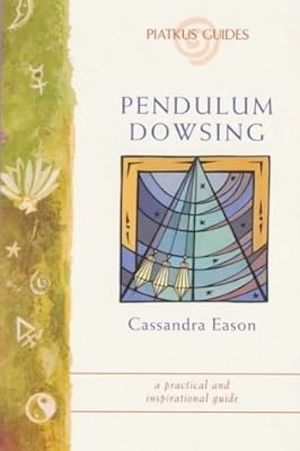
Ellis, Arthur J. The Divining Rod: A History of Water Witching. (United States Geological Survey, Water Supply Paper 416)
Washington, DC: U.S. Government Printing Office, Department of the Interior, 1917.
59 pages. Softcover pamphlet, 6" x 9 ", in stiff stapled wraps, Illustrated; includes a 25 p. bibliography, index,
Reprinted 1938.
Reprinted 1957.The U. S. Geological Survey printed this monograph in a half-hearted attempt to discourage the widespread belief and faith that people have in water witching. To this end it contains "a summary of divining rods and the people who have made claims for them."
Leaving the author's anti-dowsing objective aside, the bibliography he assembled is remarkable and covers 500 years of references to dowsing. This list was updated with every reprinting, and my 1957 edition covered publications from 1532 ("A True Yet Brief Description of The Wand of Mercury") to 1949 ("Psychical Physics").
Yes, our tax dollars used to be spent on legitimate historical research projects. Not no more, folks. Not no more.
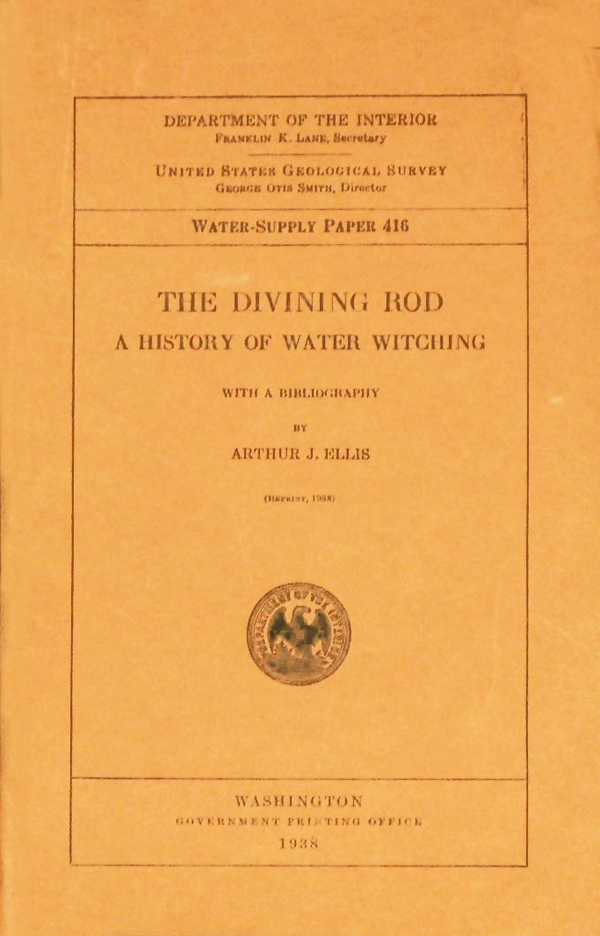
Evers, Ona C. Everybody's Dowser Book: A guide to Locating Water, Valuable Minerals, Lost Objects and People -- To Discovering the Inner Riches of the Mind
Onaway Publications, 1977.
70 pages. Saddle-stitched.Introduction 9
1. A Secret Water Witch 13
2. The Rods and Their Uses 22
3. Depth, Volume, and Questions 32
4. Diary of a Dowsing Dud 37
5. Maps and Hands 44
6. Traps and Pitfalls 52
7. Endings and Beginnings 59
Bibliography 66
Index 68This little blue book is dear to me because the author and illustrator was a friend of my family.
Ona C. Hardy Evers (1916-2015), was raised in Santa Cruz County, California. Her mother was a descendant of one of the original 25 Californio families who received Spanish land grants, but by the time i was old enough to really get to know her, she was living an artistic and bohemian life with her husband Robert Evers and their children, in the houseboat community that had developed in the slough along Lucky Drive in Marin County, near my mother's life-long friends the Rices. The Evers and Rice kids were around my age, and although we attended different schools, we played together during the summer months. Ona had a background in theater and went on to become an award-winning water color artist, so i was quite surprised when, in 1977, she wrote and self-published "Everybodys Dowser Book" and gave me a copy. I was delighted with the book and with her can-do approach to dowsing. She made it look easy and fun, and her light-hearted attitude convinced many people in the local artistic community to give dowsing a try -- which resulted in a number of previously skeptical folks realizing that they too had the gift for locating water!
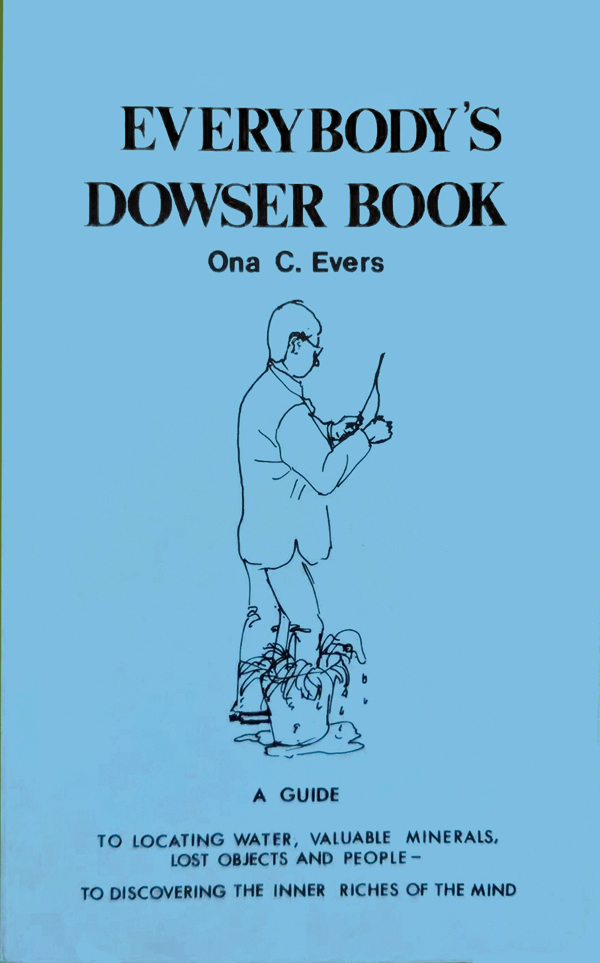
Finch, William J. The Pendulum and Possession.
Cottonwood, Arizona, Esoteric Publications, 1975.Excellent instructions on how to use a pendulum.
Finch, Elizabeth and Bill [William J.] Finch. The Pendulum and Your Health.
Cottonwood, Arizona, Esoteric Publications, 1980.Dowsing for the diagnosis of disease and to improve overall health.
George, Karl. Dowsing: The Science of Water-Witching.
"Edited by My Daughter, Carol M. Bernhardt"
Laurel, Montana, Karl George, 1974.
140 pages plus two laid-in sheets (4 pages) of illustrations.This is one of the most quirky and idiosyncratic books on dowsing in my collection. Karl George was a medical dowser and a water witch, and he also practiced numerology. He came from the bio-electric school of dowsing, and he categorized living beings and objects as having a Positive, Neutral, or Negative bio-electric charge -- and that charge could change due to circumstances. (For example, three of his clients who had recently given blood were dowsed as Neutral rather than Positive as expected, due to the temporary imbalance caused by giving blood.) Furthermore, by using numerology he could determine which of the four elements (Earth, Air, Fire, or Water) might change a sick or Negative person to Positive and bring about a remission or a cure.
Part of the book consists of case histories of people who received medical dowsing and treatments from him, and part of the book consists of the accounts of the hundreds of detailed tests and dowsing experiments he conducted over several years.
He tested 243 people for their dowsing ability. (8.3 percent could not dowse at all; the rest could.) He tested whether he could dowse water through asphalt. (He could.) He tested how long it takes a fish to dowse as "dead" if it is gutted but its head is left on the body. (Two to three minutes.) He tested whether a novice dowser coud lose her ability to dowse a living plant as "alive" if a man stroked her arm for two minutes and changed her polarity from Positive to Negative. (She did lose her ability, but after four minutes of resting, her polarity returned to Positive and she was able to dowse again successfully.) He tested whether a person has to be standing on the ground to dowse. (They do not. He and a friend of his were both able to dowse while standing on one another, on glass, or on a stool.)
I could go on and on with examples. Karl George certainly did. If you see this book for sale, PAY ANY PRICE. It is marvelous, entertaining, and, frankly, the only book of its kind i have ever seen in the field of dowsing.
Okay, one more example: Brick Cheese with Caraway Seed, Sharp Cheddar Cheese, Blue Cheese, Sour Dough Starter, Yoghurt, and Beer all dowsed as Positive. American Processed Cheese, Butter, and Margarine all dowsed as Neutral. The Positive foods have more "life" or "growth" in them.
Okay, okay -- just one more: Only 1 out of 30 people who have had a malignancy surgically removed return to Positive. Most remain Negative or at best Neutral, and the site of a former malignancy can be accurately dowsed in as little as 30 seconds, even on those lucky ones who have returned to Positive.
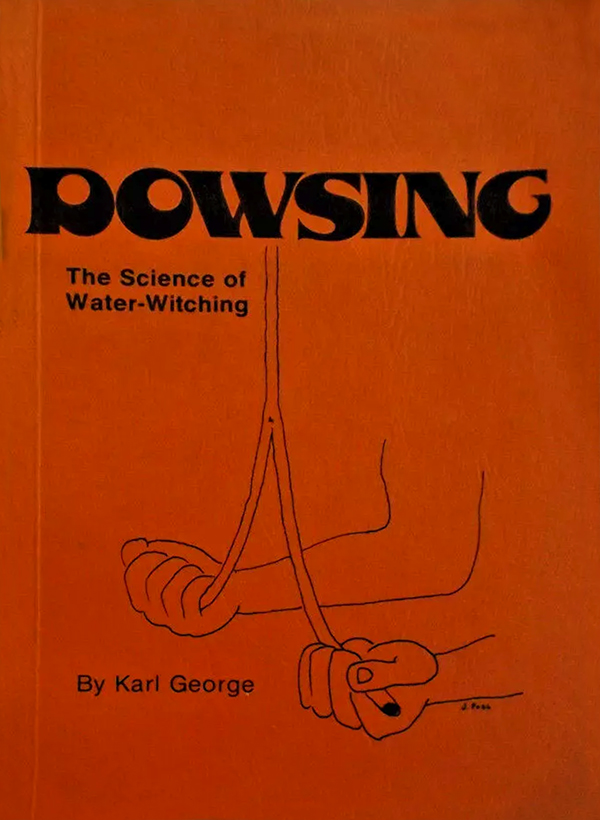
Graves, Tom. Dowsing: Techniques and Applications.
London, Turnstone Books, 1976.
Graves, Tom [Editor]. Dowsing and Archaeology: Articles from the Journal of the British Society of Dowsers.
London, Turnstone Books, 1980.
HarperCollins Distribution Services, 1980.
Paperback.I enjoyed this book greatly and consider it both well-written and intriguing, in that it bridges the gap between modern high-tech archeological tools such as metal detection and LIDAR, and the older, less "scientific" method of getting a "feel" for the land and letting your dowsing sense lead you to "treasure."
This collection of articles from the Journal of the British Society of Dowsers was published as a companion to "Site and Survey Dowsing," edited by Clive Thompson, and the two form an admirable testament to Britain's contributions to dowsing literature. Authors include R. Allendar Smith and Guy Underwood.
For more on the British school of dowsing, see the entries for Clive Thompson, Major General Jim Scott Elliot, Marguerite Maury, Mary E. Pogson, W. H. Trinder, and Vernon D. Wethered.
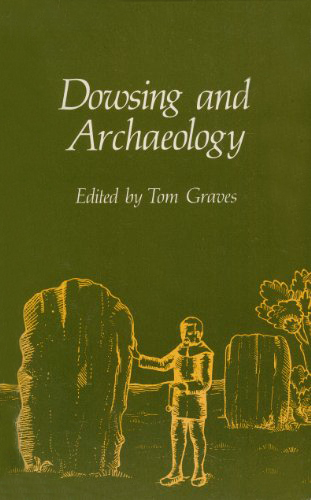
Graves, Tom. The Diviner's Handbook: A Guide to the Timeless Art of Dowsing
Wellingborough, The Aquarian Press, 1986.
Destiny Books, 1986.
192 pages. Paperback.I know of three cover variants for this book, and have chosen the one i like the most.
Tom Graves, a well-respected British dowser, presents a complete guide to Old School dowsing. The back cover copy describes it as well as i can, albeit with a modest lack of hype. It really is better than described here, to tell the truth:
"Tom Graves' book is simple, lucid, and yet comprehensive. The best thing of its kind ever done on dowsing!" --Dr. Lyall Watson, Author of Supernature Anyone can learn to dowse-for precious metals, missing persons, water, the solution to a problem, or a myriad of other objectives. All that is required is practice, awareness, and a working knowledge of basic dowsing principles and mechanics. Tom Graves' guidebook provides the tools whereby your natural ability to dowse can be turned into a reliable skill. One of the oldest arts and sciences known to man, dowsing is widely used today in fields as diverse as medicine and archeology. The Diviner's Handbook moves directly into the firsthand experience of dowsing and the heightened sense of awareness that is the dowser's most important ally. With clear, insightful explanations and generous illustrations, the author shows you how to:
• Make and use simple, effective dowsing instruments
• Develop dependable methods of analytic and intuitive interpretation
• Experiment with a wide range of traditional and personal dowsing techniques
• Locate people, objects, and information
• Diagnose illness; and
• Attune with plants and animals.
Each of us is capable of detecting the subtle emanations and vibrations that surround us. The Diviner's Handbook helps you develop your own, individual talent and technique for dowsing as a key to greater knowledge and the time-honored art of divination."
Graves, Tom. The Dowser's Workbook: Understanding and Using the Power of Dowsing.
New York, Sterling Publishing, 1990.
173 pages, Illustrated Papaerback.
Hitching, Francis. Pendulum: The Psi Connection.
UK, Fontana, 1977Hitching, Francis. Dowsing: The Psi Connection.
Garden City, N.Y., Anchor Press, 1978
Howells, Harvey. Dowsing for Everyone: Adventures and Instruction in the Art of Modern Dowsing.
Brattleboro, Vermont, The Stephen Greene Press, 1979.
Viking Penguin Inc., 1979.
ix + 117 pages, Trade Paperback, with drawings by Ingrid Beckman.Harvey Howells, like Robert Ater and Gordon MacLean was one of the intrepid dowsers of Maine -- he was born in California, but lived in Brunswick. He dedicated this book to MacLean, with whom he had first bonded over their shared Scottish ancestry, but who eventually introduced him to dowsing in 1975.
As a recent convert to dowsing, Howells set about to review the history of the art, demonstrate its numerous applications, and explain basic dowsing techniques. In his Author's Note, he wrote that he sought to "avoid the occult" and to simply relate what he had read, seen, and witnessed himself. He also made specific reference to the influence that Kenneth Roberts' 1951 book "Henry Gross and His Dowsing Rod" had had upon him.
The tone throughout this book is personal, narrative, engaging, and even playful, in a literary sense, with chapter titles reminiscent of A.A. Milne's "Winnie-the-Pooh" - such as "Chapter 1. In Which I Am Introduced to the Art by a Master Dowser."
For some reason unknown to me, this book -- although found for sale all over the internet, and released relatively recently, as far as dowsing books go, with distribution from a major publishing house -- commands very high prices, and can rarely be had for less than $100.00.
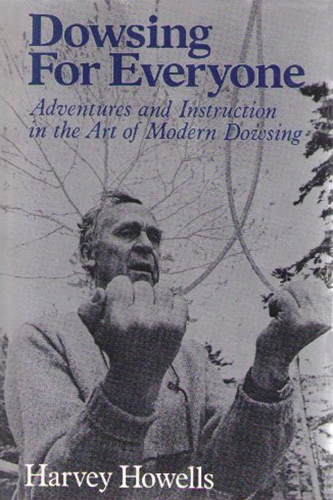
Howells, Harvey. Dowsing: Mind Over Matter.
Brattleboro, Vermont, The Stephen Greene Press, 1982.
Hunt, Brenda. A Beginner's Guide to Pendulum Dowsing: Unravelling the Mystery.
Brenda Hunt, 2012.
128 pages. Paperback.After a brief history of pendulum dowsing, and a throwaway glance at the basics of hard target dowsing, the author gets right into the thick of the New-Age method, in which you will learn how to "program" a pendulum and how to incorporate it into your daily life as you ask such psychologically pressing questions as, "Is it right for me to take this vitamin?" and "Is this amethyst a good energy to help me avoid headaches when using a computer?"
Dowsing for divination or "fortune telling" is discouraged -- in fact, the terms, "take care" and "take great care" appear liberally throughout the section that deals with asking about the future. The author is more comfortable dowsing for food allergies, encouraging readers to ask, "Will this particular type/brand of bread give me hiccups?"
I consider this to be another in the long list of terminally neurotic 21st century pendulum dowsing books in which literally every aspect of life is examined for verity, as if one had no common sense at all and must constantly be pestering the Divine for information about the relative freshness of this or that basket of huckleberries.
Brenda Hunt lives on the West Coast of Ireland and is a member of the British Society of Dowsers.

Hunt, Brenda. Dowsing for a Happy Healthy Home: How to Work with Dowsing in Every Area of Your Home, from First Choosing It to Decorating and Energy Clearing. Improving the health of your home with the art of dowsing.
Brenda Hunt, 2014.
117 pages. Paperback.New Age methods are utilized to help home owners and apartment dwellers locate a place to live, map energy zones, and make interior decoration choices with a pendulum, thereby improving the health of the home with the art of dowsing.
From Hunt's description of her text:
"In this book you will learn to work with your dowsing pendulum to ensure that your house does become -- and remain -- the home that you want it to be. Dowsing can help you find the right property at the right time in your life. It can help you create an energy map for you home so that you can use the rooms for the right purpose. It can help you make decisions about choosing furniture, color schemes and decor and avoid expensive mistakes. It can help you clear and balance the energy after life changes and when you want to create a new energy in your life. In fact, you can work with your dowsing throughout your home and the spaces you spend time in."

Jenkins, E. Vaughan [as by "The Proprietors of "Water"]. Water Divining, Reprinted from "Water," A Journal for Water Supply, Irrigation, Sewage Works, Hydraulic Machinery, Lifts, Pumps, Water Softeners, Filtration, Docks, Canals, &c., &c."
London: The Proprietors of "Water", n.d. (circa 1902).
Small octavo hardcover. 154 pages + viii pages of ads, with 37 illustrations, including a frontis-portrait of E. Vaughan Jenkins.Here we have a collection of essays on the subject of water divining previously published in "Water, a Journal for Water Supply, Irrigation, Sewage Works, Hydraulic Machinery, Lifts, Pumps, Water Softeners, Filtration, Docks, Canals, &c., &c." The text is accompanied by reviews, black and white illustrations, biographical information, and priceless photos of Victorian-era dowsers (men, women, and children), plus advertisements for related services, including professional dowsers, well-drilling services, and drilling equipment,
A time-capsule of British dowsing history, it is as charming as it is astonishing. Many of the dowsers showcased here were also well-drillers, and a common phrase found in their ads is "No Water No Pay."
My favourite photo and caption is of a bearded man in a black suit with a bowler hat, standing with his back to an ivy-covered brick wall, with a small Y-rod in his hand, pointing down, and the caption, "Fig. 23 - Mr. John Stears in the Act of Divining."
Also charming is "Fig 31 - Mrs Mugleston." This thin, severe-looking woman lived in Kelvedon Hatch. Clad in black from her tall, feathered hat down to her feet, she holds a Y-rod out in a pasture, looking for all the world like "The Wicked Water-Witch of the West." She told Mr. Jenkins that she had learned how to dowse from John Mullins (the author of "The Divining Rod: Its History, Truthfulness and Practicability" -- see below) and she said that locating underground water gave her "a creeping or prickly sensation in her arms and hands, and a resistance, as if something prevented her from going any further."
Jurriaanse, D. The Practical Pendulum Book
New-Age method. Introspective dowsing. 38 Pendulum Charts. 'Nuff said.
Kaufman, Ola. Successful American Dowsers: Professional Dowsers Improve Our Health, Our Environment, and Our Futures.
Xlibris Corp. 2000
124 pages. Harcover and paperback; print-on-demand.Publisher's ad copy: "This book contains the true stories of successful Dowsers who have found: Gold, Oil, Minerals, Treasure, Missing Persons and More. These Americans dowse to find answers to: Health, Problems, Emotional Problems, Unhealthy Environments, and More. Some Dowsers reach out further to Contact Guardian Angels, Develop Their Inner Selves, Meet Others, and More."
Books and magazine articles that describe the successes of dowsers who have located water, oil, minerals, treasure, archaeological sites, and missing people, pets, or objects used to be a mainstay of the publishing field. On the one hand they kept dowsing in the public eye, and on the other hand they subtly pointed out the rarity of truly professional dowsers -- people who, like Verne Cameron, Bill Cox, Henry Gross, Gordon MacLean, Earl Pyle, the Pogson family, and E. Vaughn Jenkins, made hit after hit and were even able in some cases to earn in living from dowsing.
Telling these stories, and ensuring that the names of successful dowsers are kept fresh in memory, and not relegated to the dim dust of the past, is reason enough for a book like this to exist. In a sense, it is also the reason for my creation of this bibliography.

[Kopp, J.A.] Effects of Harmful Radiations and Noxious Rays: A Series of Research papers by Noted Scientists and Authors.
Danville, Vermont, The American Society of Dowsers, 1974.
32 pages. Saddle-stitched.
Here we have a convenient English translation of the 1970 - 1971 research papers of the German dowser J.A. Kopp on harmful earth energies, with an appendix in which Gordon MacLean, a Trustee and Past President of the ASD, formally revises his theories about geopathogenic phenomena to accord with Kopp's theories. This short booklet was published by the American Society of Dowsers in 1974, with Kopp's name strangely not mentioned on the title page..Kopp's writing is dense and not reader-friendly, but "Effects of Harmful Radiations and Noxious Rays" is a significant early look at the usefulness of dowsing as a technique that may allow us to locate and identify noxious earth energies that are harmful to human, animal, or plant life. These may include source points for radon, fault zones, subduction zones, collapsing linestone caverns, leaking underground gass pipes, water veins, magma intrusions, and other potentially disruptive or even dangerous geological or spiritually energetic anomalies that interfere with the tranquility of the beings who live above them
Kopp's work, with MacLean's endorsement, gave rise to an entire sub-field of hard-target dowsing that developed around the concept of relocating beds, or, more radically, introducing remediative metallic rods and loops into the ground in areas which were producing negative effects -- a sub-form of practical dowsing that others, such as Gregory A. Storozuk, came to call the diversion of "geopathic stress zones."
Kroeger, Rev. Hanna. The Pendulum, The Bible, and Your Survival.
Boulder Colorado, New Age Foods, 1973.
Stapled Booklet.Kroeger, a New Age author, presents pendulum dowsing in the reference-frame of metaphysical Christianity. "The gret University of of Occult Knowledge is open now and Christ is our President," she declares. "We are coming from many walks of Life, we are drawn together under the banner of the Light Bearers of the Aquarian Age."
She also gives some intriguing variations on pendulum dowsing, including the interesting instruction to beginners who can't get the pendulum to move, to hold it over their knees, especially their left knee.
From a review in the American Dowser Quarterly Digest, Vol 14, No. 2, May 1974: "The part the pendulum can play in helping one meet personal problems is handled simply and directly and reverently. After reading, one will wonder that so much that is helpful can be found in one booklet."
This issue of the Quarterly Digest also contains a 2 1//2 page excerpt from the booklet, which deals with establishing "personal patterns" (which some call "codes") for communicating with or through a pendulum; it is solid advice, and well explained.
Layne, Meade, and Riley H. [Hansard] Crabb. The Cameron Aurameter.
Garberville, California, Borderland Sciences Research Foundation, 1952;
Reprinted 1970, 8th printing 1979 (Stapled), 9th printing, 1986 (Ring-Bound)
95 pages, Paperback.This is a good introductory text by Meade Layne (1882 - 1961) and Riley H. Crabb (1912 - 1994) that will teach the user the history and the ins and outs of the Cameron Aurameter, a complex, spring-loaded combination between an L-Rod and a Bobber. Invented and originally produced for sale by Verne L. Cameron (1896 - 1970) as the Water-Compass, the Aurameter is sometimes called "The Cadillac of Dowsing Tools" because it is both expensive to manufacture and because Cameron himself encouraged users to purchase models coated in precious witness-metals, including the literal Gold-Plated Aurameter. Still manufactured, and still a popular tool among practical and medical dowsers, the Aurameter has a reputation as quirky, difficult to become attuned to, and absolutely unsurpassed for sensitivity once the user finally figures out how to hold it properly.
Meade Layne was a well-known researcher into obscure and fringe science topics such as geomancy and etheric physics in the 1940s and flying saucers in the 1950s. He founded the Borderland Sciences Research Foundation in 1951 for the purpose of studying parapsychology and extended consciousness.
Riley Hansard Crabb was not a notable dowser per se, but as the director of BSRF from 1960-1985, he published many articles in mimeographed fanzine form that dealt with unconventional science. Some of his titles include "Spacecraft from Beyond the Sun," "Personalizing the World Power Grid," "Radionics: The New Age Science of Healing," and "Flying Saucers on the Moon."
This booklet on the Cameron Aurameter was an early publication from the BSRF. Another book of the same name was published by Cameron himself in 1953. A revised and expanded edition including both books was published by Bill Cox in 1997 under the title "The Original Cameron Aurameter Book" -- see more about that edition under Bill Cox.
One of the photos on the cover of a later edition of this book shows us a hand-painted signboard. I cannot make it all out, but here is what i can decipher.
        -------- Prospect No. 2 ---------
    Largest Water Producing Well in So. Calif.
1. Depth of Well: 1776'       6. Present Pumping Rate:
2. Size of Casings:              35,600 Gal. Per Mon.
   xxxxx                      7. Engine Horsepower: 200
3. Cost of Well: $1,291.00    8. State Water Level: 182'
4. Power of the Well: Elec.   9. Pumps Set at 200 Ft.
5. xxxx: Car                 10. Temp. of Water: 89• F.
There is also a cut-line under one of the photos: "Governor Brown and Vern [sic] Cameron." That would have been Edmund G. "Pat" Brown (1905 – 1996), California's governor from 1959-1967.
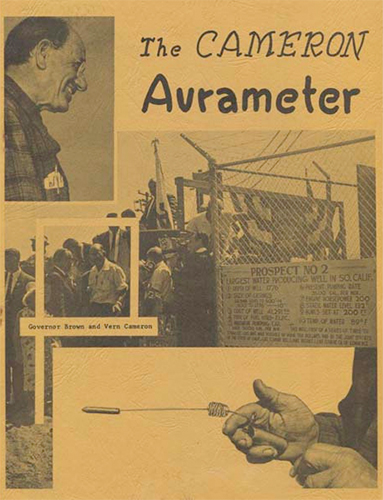
Leftwich, Robert H. Dowsing: The Ancient Art of Rhabdomancy.
Aquarian, 1977.
64 pages. Paperback.
Lethbridge, Tom C. [Thomas Charles] Ghosts and Divining Rod.
UK, Routledge & Kegan Paul, 1963This book is about ghost-hunting with the tools of dowsing. The author, Thomas Charles Lethbridge (1901-1971) was an English archaeologist, parapsychologist, and explorer. A specialist in Anglo-Saxon archaeology, he served as honorary Keeper of Anglo-Saxon Antiquities at the Cambridge University Museum of Archaeology and Ethnology from 1923 to 1957, and over the course of his lifetime wrote twenty-four books on various subjects, becoming particularly well known for his advocacy of dowsing.
Lethbridge, Tom C. [Thomas Charles]. The Power of the Pendulum.
New York, Routledge & Kegan Paul, 1976
138 pages. Hardcover.Published posthumously, "this is a conclusion to the author's lifelong study of the worlds of the unexplained. Through his experience with the pendulum and his work with dreams, Lethbridge concluded that there are other realms of reality beyond this one and that the soul is probably immortal."
Blurring the boundary between scientific pendulum dowsing and exploring divination through dreams and the occult, this book -- and its author -- has many devoted fans, and has remained a favourite for decades.
The publisher notes that, "T.C. Lethbridge, who died in 1971, was an archaeologist, psychic researcher, dowser and explorer. He was for thirty years Director of Excavations for the Cambridge Antiquarian Society and for the University Museum of Archaeology and Ethnology. He was on three Arctic expeditions, several Hebridean exploratory expeditions and two voyages to the Baltic in square-rigged sailing ships. He was also, as Colin Wilson wrote, 'one of the most remarkable and original minds in parapsychology'."
[Life Savers], Life Savers Book-O-Secrets for 'Holesome Entertainmint'.
Life Savers, Incorporated, Port Chester, N.Y., 1931
32 pages plus colour wraps; only one chapter on Divining Rods, but what a cool booklet; published by a candy manufacturer.
- Secret Writing (writing in code)
- Ventriloquism or How To Throw Your Voice
- How To Make Invisible Ink
- Secret of Making Everlasting Ink
- Finding Out a Person's Age
- Secret of the Moslem Oracle
- Secret of Making a Gold-Finder
- Divining Rods
- Secrets of Telling Fortunes
- Fortune Telling by Tea Leaves or Coffee Grounds
- Fortune Telling by Crystal Gazing
- Railroad Signals
- Secret Hiding Places
- Secret Initiations
- Secret Initiations of the Ancient Persians
- Initiation of the Druids
- Secrets of Making Money
- Secrets of the Woods and Trails
Lonegren, Sig. Earth Mysteries Handbook: Wholistic Non-Intrusive Data-Gathering Techniques.
Danville, Vermont, USA: The American Society of Dowsers. 1985.Methods of gathering astronomical, sacred geometrical, dowsing and other information at sacred sites.
Lonegren, Sig. Spiritual Dowsing.
Bloomington, Indiana, USA, AuthorHouse. 1986.
England, Gothic Image, 1986.
Reprinted 2004.A history of the earth energies, healing, and other uses of dowsing.
Maby, J. Cecil, and Franklin, T. B. The Physics of the Divining Rod, Being an Account of an Experimental Investigation of Water and Mineral Divining.
London, George Bell, 1939.
MacLean, Gordon. A Field Guide To Dowsing.
Danville, Vermont, American Society of Dowsers. 1971.
First Edition:
Dowsing: An Introduction to an Ancient Practice. A Book of Instruction.
South Portland, Maine, 1971.
46 mimeographed pages with 6 illustrations within the text, bound in illustrated card covers.
Reprinted as:
A Field Guide To Dowsing: How to Practice the Ancient Art Today
Danville, Vermont, American Society of Dowsers. 1976.
44 pages typeset and printed, with illustrations.
This book is currently being kept in print as of circa 2000 as
A Field Guide To Dowsing: How to Practice the Ancient Art Today
Danville, Vermont, American Society of Dowsers.
32 page photocopied saddle-stitched pamphlet missing some illustrations and some outdated information about the ASD.Brief as it is, "A Field Guide To Dowsing" by Gordon MacLean (1889 - 1979) is one of the most important books on all forms of dowsing ever published and it has been the most valuable and instructive text used by the present bibliographer. Highly recommended. If you only buy one introduction to dowsing, this should be it. If ever a book deserved a really clean restoration, inclusion of other material by the author, and reprinting for wider distribution, this would be it. Maclean was admired and loved by many, and for more about his charismatic effect on other dowsers, see "Dowsing for Everyone" by Harvey Howells.

MacManaway, Dr. Patrick. Dowsing for Health
Anness Publishing Ltd., 2001.
Reprinted as
Energy Dowsing for Everyone
Anness Publishing Ltd., 2004.
Energy Dowsing for Health
Anness Publishing Ltd., 2009.
The Practical Guide to Dowsing: How to Harness the Earth's Energies for Health and Healing
Anness Publishing Ltd., 2013
64 pages - 96 pages in various illustrated paperback and hardcover editions.Publisher's blurb: "A unique, practical introduction to a powerful and ancient art, which uses simple tools such as pendulums, together with a finely tuned intuition, to provide wisdom and guidance in daily life. Includes working with earth energies, geopathic stress, place memory, power centres, chi paths, dragons and auras. Step by step dowsing sequences include assessing food vitality, choosing vitamins, minerals, flower essences, and other remedies to treat illness and improve health. How to use dowsing to reduce allergic response, find a suitable diet, and to heal yourself and others, all with practice exercises to sharpen your skills."
From the author's self descriptive bio: "Dr. Patrick MacManaway is a third-generation practitioner of the psychic and healing arts. He has an international practice working with landscape, people, businesses and projects, from domestic and commercial to agricultural and industrial. Past-President of the British Society of Dowsers, he holds a degree in Medicine from the University of Edinburgh, is a founding member of Circles for Peace, and design consultant for the Burlington Earth Clock. He is the author of several books and CDs including "The Practical Guide to Dowsing: How to Harness the Earth's Energies for Health and Healing", "Cultivating the Light Body" and "Keys To Grace". He consults and teaches worldwide with regular visits to the UK, USA, and Australia."
Most remarkably, MacManaway's autobiographical note concludes with a remarkable disclaimer:
Please note that his original title, "Dowsing for Health" has subsequently been published as "Energy Dowsing for Health," "Energy Dowsing for Everyone," and most recently as "The Practical Guide to Dowsing: How to Harness the Earth's Energies for Health and Healing." This is a most helpful book for anyone and everyone at every level -- however you will only need one of these titles as they are all the same book. He has no copyright or control over this book and apologizes if anyone has bought two copies of the same text -- always good as Christmas or birthday presents however ... spread the love.
Mager, Henri. Water Diviners and Their Methods.
London, George Bell, 1931.
Matacia, Louis J. Finding Treasure: Combining Science and Parapsychology.
Matacia, 1997.
232 pages, Oversized Softcover.Louis J. Matacia was a licensed surveyor who became a dowser. During the Vietnam War he dowsed Viet Cong tunnels and traps; his tools were the L-Rod and Pendulum. In later years he took up treasure-dowsing, and claimed quite a few successes.
"Matacia is interested in the challenge of the search and in seeking new solutions. He applies scientific knowledge and his interest in un-proved phenomena to uncover new solutions. Using his dowsing powers, Matacia has located oil reserves and buried treasures, underground wells, caves, and lost pipes. One of his most unusual assignments was to teach dowsing to U.S. Marines for use in combat during the Vietnam War. The book's Table of Contents consists of Techniques for Finding Treasures, Taking Precautions, How to Achieve Success, Treasure Hunting Contracts and Agreements." -- ASD Bookstore Catalogue, Fall, 1999.
Louis Matacia. Finding Treasure Auras 75 pages, Softcover. "This book contains stories, illustrations, drawings and photographs, including: Siting an Indian secret, rainbows with pots of gold at the end, dowsing with a Polaroid camera, ghosts on a treasure site, gold fever, death trap at Superstitious Mountain, dowsing instruments, treasure hunting, the WADI an electronic instrument." -- ASD Bookstore Catalogue, Fall, 1999.
Matacia, Louis J., with Matacia, Ginette. Treasure Hunters.
Matacia, 1996.In addition to his spiral-bound books, Matacia produced a series of five audiotapes for the American Society of Dowsers, which were released from 2000 to 2002. His work is carried on by his daughter Ginette Matacia.
The audiotape topics are:
1.- Secrets of Locating Gold and Treasure
2.- Treasure Hunting - Beaches, Rivers, Islands
3.- Treasure Hunting - Mountains, Valleys, Deserts
4.- Electronics, Radar, Digital, and Video Cameras
5.- Recovering Small Treasure
Maury, Marguerite. How to Dowse: Experimental and Practical Radiesthesia.
G. Bell and Sons, 1953.
184 pages.This is a very thorough course in dowsing, Franco-British style. The text covers many tools and methods, and describes a number of common objectives for dowsing, including agricultural and homeopathic medical radiesthesia. The author is a devotee of radionics (and provides rough plans for radionic instruments), and also embraces a fairly early description of the phenomena of remanence (here called parasitic images), telluric emissions (which some now call geopathic stress), and techniques of map dowsing. Highly recommended for anyone undertaking formal study of the matter from a practical viewpoint, within the perspective of electro-magnetic theories, and looking to see what the British Society of Dowsers had developed in the way of teaching materials by mid 20th century.
"This book consists of twenty-one lessons, each followed by a number of exercises, and deals with the subject in all its aspects (except medical) such as instru-ments used, the effect of amplifiers, samples and colors, the detection of wa-ter, minerals, telluric emissions and detection in plants and homeopathic teleradiesthesia." -- ASD Bookstore Catalogue, Fall, 1999.
Publisher's dust wrapper note: "The authoress of this book, Madame Maury, was trained as a nurse and is now the wife of the distinguished homeopathic doctor, E. A. Maury."
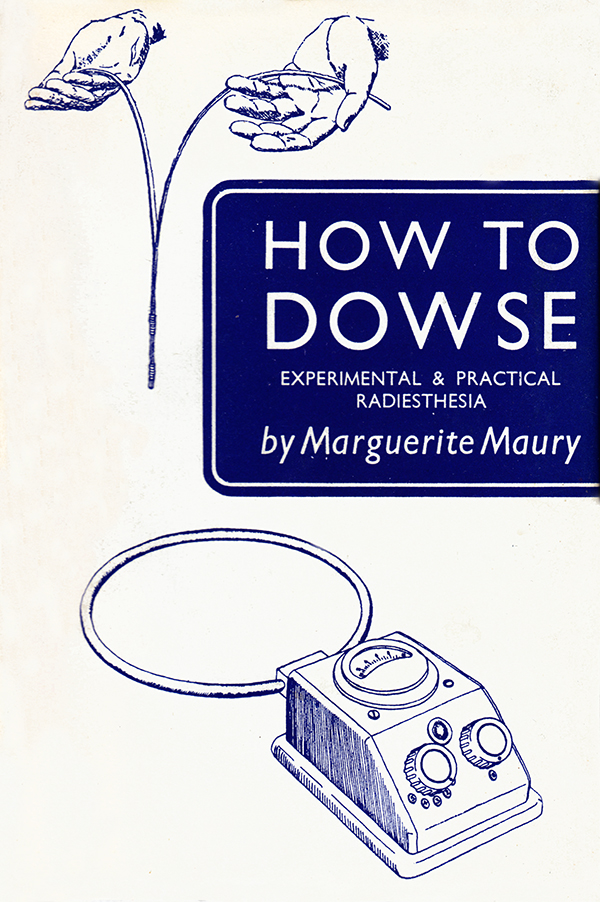
McKusick, Robert T. Practical Dowsing.
Globe, Arizona, The Association of Universal Philosophy, 1979.
Mermet, Abbé [Alexis]. Principles and Practice of Radiesthesia: A Textbook for Practitioners
English translation. London, Vincent Stuart Ltd., 1959.
English translation. Reprinted: London, 1967.
English translation. Reprinted: Robinson & Watkins Books, 1975. 230 pages.
English translation. Reprinted: Element Books Ltd., 1991. 230 pages.The term "radiesthesia" is an old one, but its continuing popularity in Europe is probably due to this book. Based on forty years of personal research by Abbé Alexis Mermet (1866-1937), a French village priest in Jussy, Switzerland, "Principles and Practice of Radiesthesia" took the world by storm and was translated into many languages, entering into English in 1959, more than 20 years after the author's death.
In terms of personal celebrity, Abbé Mermet was the European equivalent of America's Henry Gross, the obscure dowser from rural Maine whose work was popularized world-wide by the author Kenneth Roberts. The difference between the two men, however, was that Mermet needed no amanuensis, and wrote his own excellent book on the use of the pendulum in water-dowsing, prospecting for minerals, diagnosing disease, and finding missing persons. Most Old-School dowsers have read "Principles and Practice of Radiesthesia," or at least know Abbé Mermet's name.
Miller, Hamish. The Definitive Wee Book on Dowsing: A Journey Beyond Our Five Senses
(Part of the Mathemagical Ancient Wizdom Series of 5 miniature books)
Cornwall, Penwith Press, 2002, reprinted 2006.
72 pages, Illustrations by Jean Hands. Hardcover
Reality Press, 2008.
72 pages, Illustrations by Jean Hands. PaperbackPublisher's blurb:
This is a small book, but it's packed with information on the history, development and practice of the ancient art of dowsing. It will appeal equally to beginners and experienced practitioners as it moves deeper into advanced techniques, probing into some of the more esoteric uses of the age-old skill. The uses of dowsing Hamish Miller covers include finding waterpipes, streams and building foundations, checking health, allergies, body energies and chakras, dowsing in churches and cathedrals, and dowsing the earth's energy field."
There's nothing i can add to that accurate description. This is a tiny novelty gift book and the five books in the series make a nice miniature library.
Milliren, Thomas J. Learning the Art of Dowsing - Divining: A Practical Approach for the Student.
Edited by Lisa A. Verakis.
Erie, Pennsylvaia, Thomas J. Milliren, 1982.
32 pages, stapled in wraps.Milliren seeks to teach dowsing by starting the beginner with water dowsing -- the simple, basic human instinct to find water. He blends theories of the subconscious mind with those involving inherent earth energies. This is a short course in the subject and is a typical and very adequate introductory text of the kind distributed at dowsing workshops of its era.
Contents
Learning to Dowse for fun and Profit 1
Who Has the Ability to Dowse 3
How Does It Work 4
Other Important Observations 5
Tools of the Dowser 6
The "Y" Rod 8
The "L" Rod 9
The Wand 10
The Pendulum 11
Dowsing Exercises 12
Exercise No. 1 15
Holding the "L" Rods 15
Rod Polarity 16
Exercise No. 2 17
Improving Your Sensitivity 17
Exercise No. 3 20
Dowsing for Water 20
Water is Where You Find It 21
Establishing Your Dowsing Plan 22
Developing a Search Grid 24
Determining Size of a Vein 25
Marking the Dowsing Spot 26
Determining Depth of the Water 26
Dowsing Tools Available 31

Mullins, John, and Sons. The Divining Rod: Its History, Truthfulness and Practicability.
Mullins, (Colerne, Box, Wiltshire), 1893; 1894.
Small octavo. viii + 64pages. Original red cloth lettered in gilt on front board, blind borders.Black-and-white frontis-portraits of John Mullins and his son Joseph Mullins on endpapers and several black and white photos. Published under the patronage of the "War Office Authorities" and the "Crown Land Commissioners". Includes a biographical sketch of the author and noted water-diviner John Mullins, collected letters on the subject, and short essays describing successful water dowsing for his patrons, whose names occupy a four-page listing that begins with dukes, proceeds to lords, and then goes on to encompass the lesser nobility, a series of wealthy "esquires," and finally concludes with a rather lengthy series of breweries, which, of course, need extensive and bountiful sources of pure, fresh water. A lovely, practical, and rare book on water-dowsing
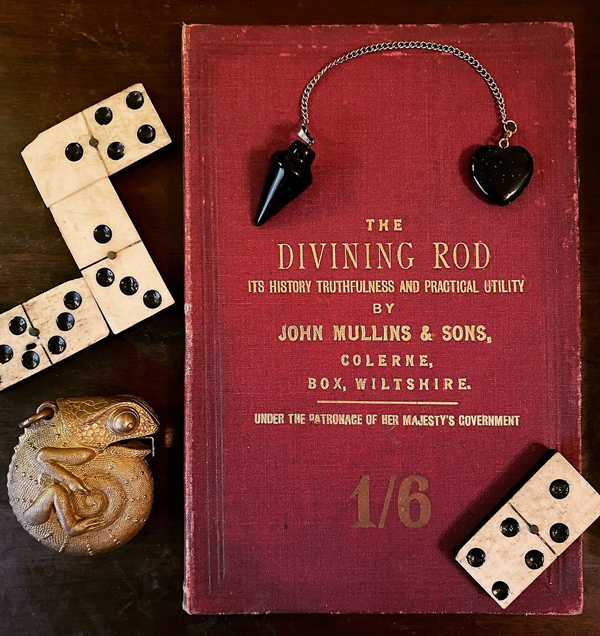
Naylor, Peter. Discovering Dowsing and Divining.
Princes Risborough, Shire Publications Ltd., 1980.
Nicolas, Jean. Jacob's Rod.
English translation of La Verge de Jacob (1693).
London: Thomas Welton, 1875.
Nielsen, Greg, and Joseph Polansky. Pendulum Power.
New York, Warner, 1977.
Reprinted: Rochester, Vermont, Destiny Books, 1987.
Nielsen, Greg. Beyond Pendulum Power.
Reno, Nevada, Conscious Books, 1988.
Palm, Stuart. Beginner Pendulum Magic.
"Access Your Psychic Self" Series.
Third Sight Studio Publishing, 2019.
126 pages.This is the first entry in Palm's "Access Your Psychic Self" series, and, as the series title indicates, his intention is to teach primarily the passive, psychological, and New Age aspects of pendulum dowsing.
In discussing several theories about why dowsing works, Palm considers everything from Angels and Demons to the Unconscious and the Subconscious -- but he has no words to say about the various electro-magnetic theories, such as subliminal movement being conveyed to the hand from the perceptive mind. This is common in books that concern themselves with soft-target dowsing. The emphasis is on how a person new to the psychic sciences can develop an innate talent for pendulum divination, particularly in the realm of self-searching and personal development.
Along the way Palm takes a couple of side-trips, one dealing with numerology and one with stones and crystals. He also includes some magical rituals or spell-work from the noted psychic Neil Scryer, making this an unusual entry into the field of dowsing books. Finally, he provides some very nice illustrations, and the back cover is given over to a convenient circular pendulum chart.
Percy, Maggie and Nigel Percy. 101 Amazing Things You Can Do With Dowsing
Sixth Sense Books, 2015
164 pages. Paperback.I am sure someone will really enjoy this book on how to use a pendulum for mental self-analysis and self-questioning, but i am not sure who. The basic premise is to first show the reader how to use a pendulum and then to list 101 topics about queries can be made -- with multiple questions listed under each topic heading, The entire idea could have been be summed up in a few pages, but instead we are given an almost endless cycle of far-reaching queries to ask our pendulums, each phrased with the excruciating precision of a business lawyer's contract:
"Considering my goals for comfort, health, and safety, give me a 'yes' when I point at the best topcoat / jacket to wear with this outfit today to best take care for me when I am exposed to the weather."
If i adopt this puppy at this time, will my cat's life be enhanced?"
"Considering my goals for my fishing trip today, please give me a 'yes' when my finger points to a location on this map that will fulfill all of my goals."
"At the subconscious level, do I belive that being poor makes me more spiritual?"
Sure, i know we all have such questions, but not all day, every day -- and many of these queries are phrased so that they are to be asked of the pendulum repeatedly, "on a scale of 0 to 10, with 0 being useless and 10 being effective ..." and that requires checking each number for a "yes" or carrying a half-circle pendulum chart marked 0 to 10 in your purse every time you leave home.
For those who want a quicker way to answer queries of the self while out and about -- as opposed to answering queries of the universe or of the minds of others (such as one's cat) -- i recommend using Spiritual Kinesiology or Body Dowsing. I have written about it here at some length: Muscle Testing, Applied Kinesiology, Applied Kinesthesiology by cat yronwode at Your Wate and Fate -- give it a try.
Percy, Maggie and Nigel Percy. Ask The Right Question: The Essential Sourcebook Of Good Dowsing Questions.
Sixth Sense Books, 2015
188 pages. Paperback.Introspective self-questioning tips for those who cannot frame their own questions.
Percy, Maggie and Nigel Percy. The Dowsing State: Secret Key To Accurate Dowsing
Sixth Sense Books, 2017
104 pages. Paperback.Techniques for self-induction into the "dowsing state," a self-hypnotic mode of focused psychic awareness. This New-Age method fits very well with the "Letter To Robin" form of dowsing espoused by Walt Woods.
Plazak, Dan. Doodlebugs and Dowsers: A History of Unusual Ways to Search for Oil
Texas Tech University Press, 2023.
304 pages. Paperback.Leave it to Texas Tech University to publish a history book on Texas doodlebuggers. This is not a pro-dowsing book, nor is it even dowser-friendly, but in its own cheerful, tongue-in-cheek way, it commemorates -- while it mocks -- the era of the Texas doodlebugs -- those who dowsed for oil. From the publisher:
"What lies beneath the ground? Our poor eyesight cannot penetrate even an inch into the soil, so for centuries, fortune-seekers have tried every way imaginable to see below the surface. Whether searching for mineral veins, groundwater, or buried treasure, people have looked for ways to avoid the plodding and backbreaking process of digging. They have followed dreams, seers, dowsing rods, and advice from the spirit world. When petroleum became an item of commerce, oil-hunters took to all these methods. Many built homemade inventions called doodlebugs, which they said could detect underground oil."
"It took a while, but science finally came up with its own toolbox of oil-finding methods in the early twentieth century. Finding oil is still expensive and risky, however. The old ways? They are mostly gone, but a few oil-dowsers still stride across fields with rod or pendulum, and no doubt people still consult dreams and psychics. And don’t pretend that you yourself haven’t wondered if that dowser might be onto something, or if that famous psychic can really tell where there is oil, or if that inventor stumbled onto a better way to detect underground oil. Of course you have."
"History is written by the victors, and scientists won over the oil industry -- rightly so. But their accounts give short shrift to the rich history of less traditional ways to find oil. Although ignored, the records of nonscientific methods and their contributions to the oil business are well worthy of study. Lacking in science, they are rich in humanity."
"Return with us now to those thrilling days of yesteryear . . . wait, scratch that . . . these things are still going on. Join us in a visit to a place where dreams, seers, and spooks are taken seriously, where forked twigs dip toward oil pools and homemade oil-finding gizmos blink or beep with the promise of riches tucked just below the surface of the known world."
Pyle, Earl. How to Make a Million Dowsing and Drilling for Oil
Hicksville, New York, Exposition Press, 1977.
136 pages. Harcover with Dust Jacket.Subtitle: "Faith, knowledge, and a spirit of adventure can lead to the discovery of oil."
The hard-sell title makes this book seem more promotional than pragmatic but it does come out of the 1950s experimentation of the notable dowser Verne L. Cameron (1896 - 1970). See the postumously published Cameron classic from 1971, "Oil Locating" for the roots of Pyle's undertakings.
Publisher's blurb: "Have you ever dreamed of discovering oil and becoming an instant millionaire? If that thought has ever entered your mind, here could be way of fulfilling the dream and turning fantasy into reality. It is more than a possibility that oil might exist in your own backyard, claims author Earl Pyle. How to go about looking for it is the key to ultimate success, and here is where Mr. Pyle's book will help, providing the seeker with the information and knowledge needed to pay off. The most important item in locating a well, according to Mr. Pyle, is the dowsing rod. Oh, yes, people have laughed at him, but he has proved time and time again that dowsing is a legitimate means for discovering a well. What it takes to make dowsing successful is a little mysticism, a strong belief in God, and a determination to do good."

Pogson, Mary E., The Art of Water Finding, with Notes on the Effect of Metals.
Backwoods, Lindfield, Sussex, England: The British Society of Dowsers, 1933.
32 page pamphlet in a blue paper wrapper.This booklet is Mary E. Pogson's account of the dowsing techniques of her husband, the late Major William Norman Pogson, F.R.I.B.A., who had begun to work on the text, with an intent to see it published in the winter of 1918, but suffered a heart attack and passed away in October of that year. Mary Pogson then took up the manuscript and saw it published in 1920 in "The Occult Review," and in 1933, due to numerous requests, she agreed to have it reprinted as a pamphlet. Included is an account of Willian Pogson's personal experiments in the location of water and metals, and with various types of dowsing rods and tools, during the period that the couple resided in Madras and Simla, India, where Mr. Pogson was an architect for the British Army.
Both William and Mary were skilled dowsers, as was Major Charles Pogson, also of the British Army in India, who presented a paper on water divining to the Bombay Engineering Congress in 1923 and located underground water sources in the countryside around Bombay.
Major Charles Pogson is known in dowsing circles as the inventor of a deceptively simple dowsing device called the Motorscope, a crank-shaft-shaped tool; he had learned dowsing from his father in England. Accompanied by his wife, he can be seen using a Motorscope while dowsing for John Barkstead's lost treasure in the Tower of London in silent 1957 film footage made for the British Pathe newsreel service: https://www.britishpathe.com/video/excavations-inside-the-tower-of-London
The Pogson family subscribed to what Mrs. Mary Pogson called the "radio-electrical or magnetic phenomena" theory of dowsing. Major Charles Pogson referred to skilled dowsers as "human galvanometers."
This is an admirable, and admirably typical, publication of the British Society of Dowsers in the mid 20th century, when the chief reasons for dowsing were locational rather than subjective and self-informational.
Roberts, Kenneth. Henry Gross and His Dowsing Rod.
Garden City, N.Y., Doubleday, 1951.
Hardcover in Dust Jacket. (tan cloth w/ black and gilt titles)
Reprinted several times.The story of Henry Gross as told by Kenneth Roberts, who first encountered him in 1947 in Kennebunkport, Maine, where Roberts lived an his farm which was being threatened by a huge forest fire. Later Roberts was instrumental in helping Gross develop his skill and to bring it to the attention of scientists.
In 1949 the island of Bermuda, which traditionally relied upon roof top rainwater catch-basins, was hit by the worst drought in four decades. Even though hydrologists declared that there was little underground fresh water available, dowser Henry Gross map-dowsed from his home in Maine the general locations of four good freshwater sources in Bermuda. Already existent wells had provided little palatable water, being mostly salty or brackish in content. When Gross was summoned to Bermuda, he accurately pinpointed his four locations which in turn were drilled for water. They were completed in 1950, and the four wells were able to produce two million gallons of fresh water per day for public consumption.
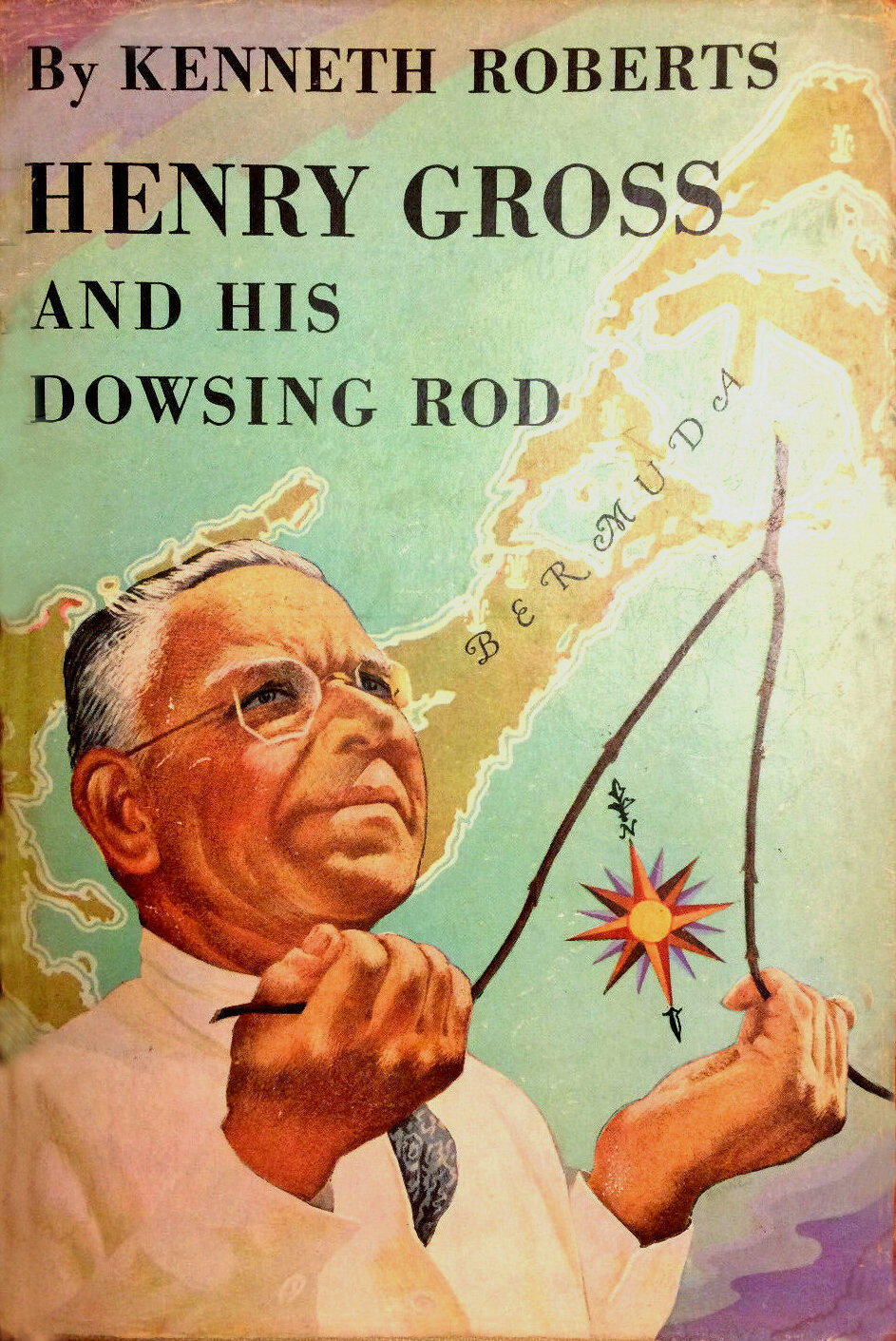
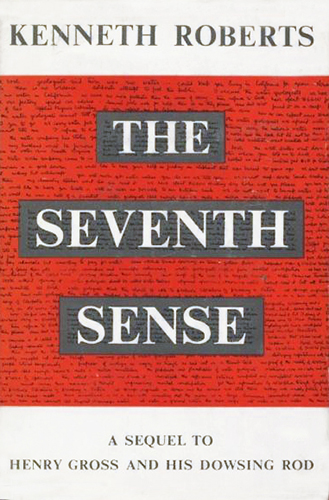
Roberts, Kenneth. The Seventh Sense: A Sequel to Henry Gross and His Dowsing Rod.
Garden City, N.Y.:, Doubleday, 1953
337 pages. Harcover. Illustrated.From the ad copy: "The Seventh Sense, to put it briefly, is the working of a dowsing rod, or its equivalent, in the hands of a competent dowser. . . This illuminating sequel to 'Henry Gross and His Dowsing Rod' is the amazing and diverting record of the year's activities of Water Unlimited, Inc., following that book's publication. It is a forthright and plain-spoken attack on the scientific milquetoasts who, the author says, are endangering our water resources by discrediting the evidence he places before them."
Roberts, Kenneth. Water Unlimited.
Garden City, N.Y., Doubleday, 1957Roberts' final book on water dowsing; the last chapters deal with Henry Gross' efforts to dowse for other substances.
Santschi, Roy Julius. Doodlebugs and Mysteries of Treasure Hunting.
1938, 1941.
Santschi, Roy Julius. Modern Divining Rods: The Construction and Operation of Electrical Treasure Finders, Including Geophysical Prospecting Methods.
1939.
Santschi, Roy Julius, [Treasure Trails]. Doodlebug Edition of Treasure Trails with Extracts from Mysteries of Treasure Hunting by R. J. Santschi.
1973.
117 pages.
Schirmer, Mark. Pendulum Workbook
New York, Sterling Publishing. 1999.
Scott-Elliot, Major General James (Jim). Dowsing One Man's Way.
UK, Neville Spearman, 1977.
TBS The Book Service Ltd, 1977,
Paperback reprint, Little, Brown Book Group, 1979.Major General Jim Scott-Elliot (1902-1996), both a soldier and an archaeologist, was also a past president of The British Society of Dowsers. After a celebrated military career, he wrote just this one book on dowsing -- but it is remarkable.
"Dowsing One Man's Way" is highly recommended by me for its clear, clean, and direct style of writing as well as its numerous pragmatic tips. It is well-illustrated with photos and line drawings, which are always important in dowsing manuals. The text is divided into in three parts, covering dowsing tools, methods used for locating varied materials (including the application of dowsing to archaeology), and a series of personal accounts of dowsing in the field.
The author comes across as a man one would have liked to have known, and as the years roll on, this book consistently remains high on my list of "best dowsing books."

Simmons, Russ. Dowsing For Treasure
1984.
92 pages.
Smyth, Hank. Precision Map Dowsing
Phoenix, Arizona, Esoteric Publications, 1982.
108 pages. Paperback.This is my favourite book on map dowsing. It is as precise as its title indicates, but it is also written in a friendly, encouraging, and personable style, and the detailed information on recommended tools and techniques is invaluable. Smyth shouts out Abbé Mermet and T.C. Lethbridge, and reprints a letter from his good friend Fred Stewart, the Tennessee Teleradiesthesiaologist. All in all, this is an inspirational and educational treatise on map dowsing.
Contents
1 The Instruments of Dowsing
2 Map Dowsing Is Easy
3 Additional Pendulum Methods
4 Dowsing for Information
5 A Map is not Enough
6 Map Dowsing with Different Instruments
7 There are Maps and Then There are Maps!
8 Samples and Witnesses
9 Rates and Rays
10 Map Dowsing for Water
11 Missing Persons
12 Map Dowsing for Treasure
13 "There's Gold in Them Thar Hills!"
14 A Quick Look Backward
15 Where Does Map Dowsing Go From Here?All i know about Hank Smyth's personal life is that he also wrote a couple of books about Texas avaiation militariana.

Staffen, Joan Rose. The Book of Pendulum Healing: Charting Your Healing Course for Mind, Body, and Spirit
Red Wheel Weiser/Weiser, 2019.The author is a proponent of "psychic healing, yoga, meditation, a Course in Miracles, Unity Church principals and prayers, and spiritual response therapy." In short, this is a book of New Age, passive, internal, psychological dowsing. Included are "30 interrelated intuitive healing charts as a spiritual guidance system," for those who are unwilling or unable to use a standard blank pendulum chart and fill it in. Note: The compiler of this bibliography considers such charts to be a waste of printed paper because most readers will only need one or two charts, and proposes that authors put only a few charts in each book -- a blank and a sample with words on it -- and then upload the rest of them as free pdfs on their or their publisher's web site. This will enable readers to download and print charts out as desired. The space saved in the book can be devoted to writing material of substance or the book can be significantly shorter, thus resulting in the killing of fewer trees. For a simple and sane approach to pendulum charts, see Anne Williams.
Stark, Erwin E. A History of Dowsing and Energy Relationships.
North Hollywood, California, BAC, 1978.
Stewart, Frederick J. Do's ... and Don't ... on Dowsing.
Fred J. Stewart, 1977; 2nd printing 1980; 3rd printing, 1983
18 pages, stapledThis is another in the long list of brief, stapled, home-published instructional pamphlets on dowsing that were distributed at the authors' workshops and by mail order during the second half of the 20th century. Fred Stewart had his booklet professionally typeset, which makes it stand out from many others of its time.
The material is well organized, non-dogmatic, and conveys an attitude i associate with men who have received training in mathematics, engineering, or the military. In the copy i have, Stewart enclosed a personal note to the buyer on stationary that depicts a scuba diver wrestling with a half-buried cannon, perhaps pointing to his having a background in underwater treasure-hunting.
Contents
I. The Typical Novice
II. The Second Time Around
III The Amazing L-Rod
IV The Big Search
V Photo and Map Dowsing
VI Be Professional - Be Prepared
VII Dowsing and the Effects on the Family
Conclusion: Do's and Don't on Dowsing
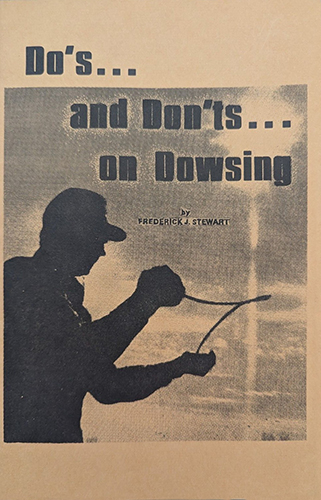
Stewart, Fred J. The "Dowser's Guide" to Gold Prospecting.
Fred J. Stewart, 1987
20 pages. Stapled WrapsContents
Introduction 1
Mountain Bound 3
Dowsing for Gold 4
Basic Panning Technique 6
Continuing the Search 7
The Mountain Revisited 7
The Sluice Box 7
Making Camp 16
Bee Stings Present a Problem 16
Return to Base Camp 16
Summary 19Stewart described himself thusly: "Native Tennessean, Veteran United States Air Force (1955-59). Graduate if East Tennessee State University, B.S. degree in 1970, M.A. 1971 in Psychology. Employed in the position of School Psychologist. Avid Dowser enthusiast, member of the United Dowsers Association, Inc., and co-inventor of a new modern line of directional locators and accessories."
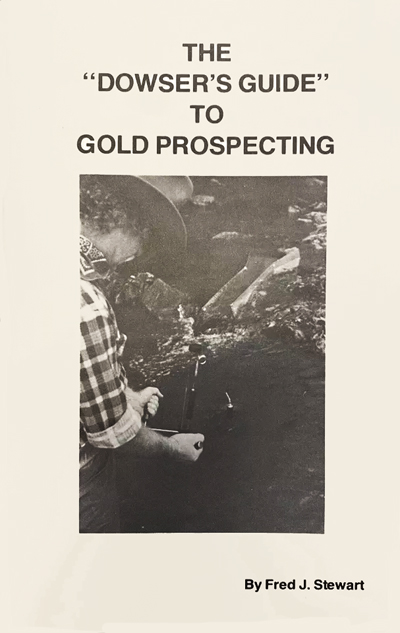
Stewart, Frederick J. "Professional" Dowsing Course for Beginning Dowsers -- Ten Easy Step Guide to Successful Dowsing.
Fred J. Stewart, 1986
19 pages, Stapled Wraps
On the cover of this booklet Stewart calls himself a "Teleradiesthesiaologist"
Contents
1. Becoming Acquainted with the Subconscious Mind Concept 1
2. Study with a Dowsing Pardner (Optional) 2
3. Basic Pendulum Instructions 4
Learning How to Hold the Pendulum 5
Establishing the Yes (Positive)
and No (Negative) Response 5
4. Dowsing with a Witness 8
5. Converting the "Witness" or Sample Method
to the "Mental Bait" Concept 9
6. Learning to Dowse with Angle Rods10
7. Using the L-Rod 12
8. Using the L-Rod in the Field Search 13
9. Learning the Fundamentals of Map Dowsing 16
10. Using a Yardstick to Apply the "Sweep" Method
to Map Dowsing 18
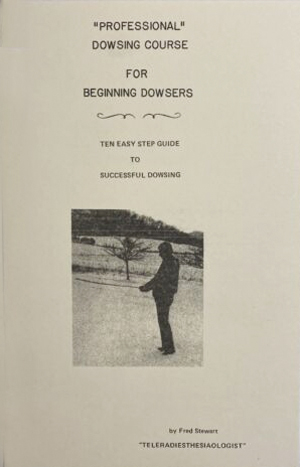
Stewart, Fred J. Treasures Found by Map Dowsing.
Fred J. Stewart, 1983
43 pages, Stapled WrapsAccording to his friend Hank Smyth, author of "Precision Map Dowsing," Fred Stewart specialized in map dowsing and lived in Johnson City, Tennessee.
Storozuk, Gregory A. Geopathic Zones and the Iron Stake method (A Dowser's Series No. 2)
1992
39 pages.This brief but valuable booklet gives full details on the subject of geopathic stress, formerly known as "noxious earth energies" or "noxious earth rays" that plague certain locations. The approach here is purely one of remediation, and Gregory A. Storozuk provides a very good mini-course in how o do just that.
For the origins of the topic of geopathic stress, see the pioneering descriptions of noxious rays and noxious earth energies in the 1941 book "New and Rational Treatise of Dowsing" by Pierre Beasse, the 1953 book "How to Dowse: Experimental and Practical Radiesthesia" by Marguerite Maury, the 1970 book "Aquavideo" by Verne L. Cameron, and the 1974 booklet "Effects of Harmful Radiations and Noxious Rays" by J. A. Kopp with an appendix by Gordon MacLean.
Geopathic stress is of vital interest to many, and deserves complete treatment in its own right, but until a book is published on the subject, let Beasse, Maury, Cameron, Kopp, MacLean, and Storozuk be your guides.

Sullivan, George. How Do They Find It.
Philadelphia, Pennsylvania, Westminster, 1975
160 pages with photos, index.
George Edward Sullivan (1927 - 2018) was born in Lowell, Massachusetts, the son of Timothy J. Sullivan (a salesman) and Cecilia Shea Sullivan (a registered nurse), He served in the U.S. Navy from 1945 to 1948. He received a B.S. at Fordham University, B.S. in 1952, and that same year he married Muriel Moran; they had a son, Timothy Sullivan. From 1952 to 1955 he as the public relations director for the Popular Library publishing house in New York, and from 1955 to 1961 he was the publicity manager for the American Machine and Foundry Co., Inc. of New York. In 1962 he embarked on an amazingly prolific career as a freelance non-fiction author on a wide range of topics, including sports, camping, aviation, and politics, geared toward children and young adult readers. His religion was Roman Catholic, his hobbies included photography and tennis, and his interest in dowsing was to produce a well-written book for Westminster Publishing in Philadelphia, Pennsylvania, to accompany his other titles for them: "How Do They Make It?" (1965), "How Do They Grow It?" (1966), "How Do They Run It?" (1971), "How Do They Build It?" (1972), "How Does It Get There?" (1973), and "How Do They Package It?" (1976)What is interesting to me about this book is the fact that dowsing was treated seriously in a book that "describes the instruments and techniques used in locating things," including "chapters on dowsing, treasure hunting, tornado tracking, locating metal ores, airport weather, and skyjacker detection."

Thompson, Clive [Editor]. Site and Survey Dowsing: An Anthology from the Journal of the British Society of Dowsers
Turnstone Press, Wellingborough, 1980.
HarperCollins Distribution Services, 1980.
x + 118 pagesThe Journal of the British Society of Dowsers is an amazing resource, but it is difficult to find individual copies of the issues that contain sought-after articles. This admirable collection, published in 1980, provides examples of practical survey dowsing and reveals how great a part dowsing has to play in construction techniques. It is a companion to "Dowsing and Archaeology," edited by Tom Graves and published in the same year.
Publisher's notes:
"This second selection from the 'Journal of the British Society of Dowsers' concentrates on the use of dowsing in building and survey work."
"Dowsing has proved of immense value in a wide range of situations -- in dock construction, in mines and mineral prospecting, in the location of gas, water and electrical supply lines, and in site selection."
"Clive Thompson is a professional architect and a dowser of note. His selection of articles provides examples of practical methods of survey dowsing and reveals just how great a part dowsing has to play in constructional techniques."
For more on the British school of dowsing, see the entries for Tom Graves, Major General Jim Scott Elliot, Marguerite Maury, Mary E. Pogson, W. H. Trinder, and Vernon D. Wethered.
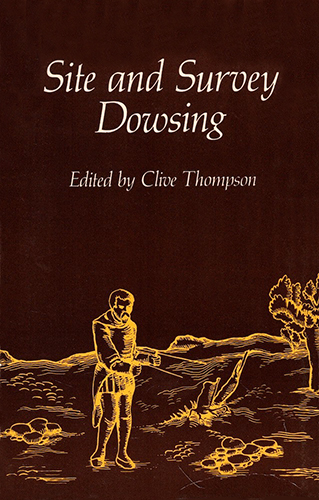
Trinder, W. H. Dowsing: The Definitive Guide to Finding Underground Water.
136 pages. Illustrated with line art and photos.
British Society of Dowsers, 1939.
Many reprints from Bell and BSD through 1962.The sub-title, while accurate with respect to finding underground water, is a great understatement, as this magnificent text on practical dowsing also covers finding minerals, archaeological dowsing, and medical dowsing. Trinder's classic outline of the stated subject in its many facets was endorsed by the influential British Society of Dowsers, as well it deserved to be. The author's familiarity with French sources is also worth noting, as he both credits and summarizes a number of concepts and tools not otherwise well known to the Anglophone dowser.
For the record, Trinder was a practical dowser who subscribed to the electro-magnetic theory of dowsing, and who believed quite strongly that routine training would enhance the inherent ability to perceive subtle shifts in electromagnetism. He is also one of the earlier dowsers to thoroughly describe the phenomena of remanence (which he did not name as such) and parallels (which some modern dowsers call by the unfortunate term "parasitic images") -- and he described ways to overcome both conditions. The table of contents gives a good impression of the scope of the work:
Introduction
Instruments and Their Use
Location, Depth, and Quantity
Serial Numbers
Colours
Dowsing and Horticulture
Medical
Hints and Warnings
Dowsing from Photographs and Maps
Historical Survey
Some Successes and Failures
Conclusion
Bibliography
IndexThis book is in my Top Ten selection of classic books on dowsing that should be in every dowser's library.
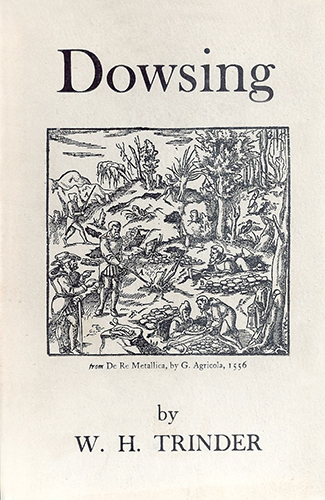
Tompkins, B. Springs of Water and How to Discover Them by the Divining-Rod.
London, Hurst & Blackett Ltd., n.d. (circa 1920).
Tromp, S. W. Psychical Physics: A Scientific Analysis of Dowsing, Radiesthesia and Kindred Divining Phenomena.
New York, Elsevier Publishing Company, 1949.
Trumpfheller, Susan Bacon. 99 Ways to Use the Pendulum
Discovery Press, California, 2002; 2nd edition, 2010.
32 pages, saddle-stitched [and wrongly paginated, as page 5 is elided].Susan Bacon Trumpfheller's little saddle-stitched pamphlets are literal eyesores, as far as i am concerned. The typography and pagination errors are maddening. However, leaving aside the fact that these are books that no bibliophile would want to confess to owning, they do add a small amount to the field of New Age, introspective, self-questioning, and psychological pendulum dowsing. Be aware that they are firmly situated in the post "Letter To Robin" era, so you must "ask permission" before dowsing, according to the New Age paradigm's embedded rule-set.
"Sue Trumpfheller graduated from Michigan State University with a BS in Mathematics. A teacher, author and personal/business coach, she became a dowser in the late 1960s and began working with labyrinths in the late 1980s. She is the creator of Chi Patterns and Chi Intention Cards, and resides in Southern California."
Trumpfheller, Susan Bacon. 99 More Ways to Use the Pendulum
Discovery Press, California, 2008.
30 pages, saddle-stitched [and wrongly paginated, as the count ends on page 27]Each book in the "99 Ways" series consists of exactly 99 questions you can ask yourself via pendulum divination. Obviously, most of us have plenty of questions of our own, which means that the 198 questions offered by Trumpfheller do fall short of humanity's ultimate quest for knowledge, but still, the author does open up quite a few inquisitory byways for those who never thought to ask their pendulum which water filtration system to buy, which dentist to choose, or whether to get divorced.
Other questions suggested cover an idiosyncratic gamut from which font to select when typesetting a book (and in this i feel that Trumpfheller's pendulum failed her) to which junk to eliminate from your life (i could say something snarky here, but as my bibliophilia verges on hoarderism, i will let it rest).
Recommended only for the terminally eccentric and for collectors of amateur zines.
Underwood, Peter. The Complete Book of Dowsing and Divining.
London, Rider & Company, 1980.
229 pages. Hardcover with dust jacket; includes index, bibliography, and illustrations.The publisher supplied these comments about the book:
"This comprehensive volume on dowsing and divining - from the twig and the pendulum to motorscopes and bare hands -- traces the story of these fascinating and enigmatic phenomena from its origins in the world of fairy tales and mythology to recent theories that the enigma can be explained in terms of present-day psychology. The force present in the act of dowsing and divining can be compared to the sensitivity of men and women suffering from rheumatism who feel, in advance, changes of weather."
"Theories that have been brought forward to explain its presence include suggestion, radiation, colour, the existence of a sixth sense, and changes in the earth's magnetic field. As there are many possible explanations there are also many types and applications of dowsing and divining: map dowsing; being eggs; radiesthesia; the diagnosis and cure of disease; locating missing persons; forces, fields and rays; and detecting thieves."
"The author tells of dowsers past and present: Robert Leftwich who located abandoned tunnels and other underground hazards; Major Harold Spary who dowsed for the Royal Aircraft Establishment and the Royal Engineers during World War II; William Young who charged 200 pounds a day in 1971 for dowsing; Tom Lethbridge who investigated Viking graves on Lundy Island; Henry Gross who discovered Bermuda's first natural wells."
"Even today large building and contracting firms employ resident site engineers who use sophisticated sets of divining rods. The book introduces us, in lucid and readable style, to the fascinating world of dowsing and divining, and gives the reader full instructions on how to attempt to become one of this international community."
Van den Eerenbeemt, Noud. Divination by Magic: Divinatory Techniques Taken from the Instructions of a Secret Esoteric Lodge
York Beach, ME: Samuel Weiser Inc., 1985. First American English language edition.
64 pages. Softcover, octavo.From the publisher: "The divinatory techniques and descriptions presented here were taken from the instructions of a secret esoteric Lodge, and are written in the form of letters from teacher to student."
Vogt, Evon Zartman, and Hyman, Ray. Water Witching, U.S.A.
Chicago: University of Chicago Press, 1959.
248 pages. Hardcover in dust jacket.
2nd ed. Chicago: University of Chicago Press, 1979.
xi + 248 pages. Illustrated. Harcover.Ad copy: "In their quest to understand water witching, the authors also explore such related phenomena as hypnosis, mind reading, talking horses, and ouija boards. The book, which includes an appendix on scientific methods of locating underground water, is an enlightening excursion into contemporary folkways and an example of the scientific method at work."

Wayland, Bruce and Shirley Wayland. Steps to Dowsing Power.
Life Force Press, 1976.

Weaver, Herbert. Divining, the Primary Sense: Unfamiliar Radiation in Nature, Art and Science.
London, Routledge & Kegan Paul, 1978.
140 pages, notes, photos and illustrations..Ad copy: "Like dowsing, divining detects radiation from objects and organisms, using a Revealer Field Detector device."
Webster, Richard. Dowsing for Beginners: How to Find Water, Wealth and Lost Objects.
Llewellyn Publications, 1989, and still in print from Lewellyn under this title in 2019.Webster, Richard. The Art of Dowsing.
(this is the cover title; it is still Dowsing for Beginners on the title page)
Reprinted by Castle Books and by Book Sales, 2001.Richard Webster is the author of dozens of educational books on occult and metaphysical topics. This book, under whatever title and whichever publisher it is found, is an excellent introduction to the topic, generously illustrated, and well presented -- as is true of all of Webster's books.
The author's concern here is practical dowsing, and he does not delve into informational or subconscious dowsing. He is from New Zealand, and it thus seems only logical that his experiences and interests developed out of the old British school of dowsing. I highly recommend this book, and am assured that as long as it remains in print, it will be one of the most popular titles on the subject.
Webster, Richard. Pendulum Magic for Beginners: Tap Into Your Inner Wisdom
Llewellyn Publications, 2002 [and still in print as of 2020].
240 pages.This is another solid classic from Richard Webster, and belongs in every dowser's library. The emphasis is on the pendulum as an intuitive tool for self-questioning of the subconscious mind, and as such, it epitomizes the New Age school of dowsing.
Included are New Thought ideas, such as how to use positive affirmations, and modern psychological Self-Help Movement concepts, such as how to revise internally programmed self-destructive behavioral patterns as you identify what you truly believe about yourself and others. All of this material is brought together in a pragmatic and informative way that is free from restrictive theological, cosmological, or doctrinal assumptions, and thus the book is accessible to all, no matter what their cultural or religious beliefs may be.

Wethered, Vernon D. The Practice of Medical Radiesthesia.
London, L. & N. Fowler, 1967.
Reprinted by Beekman Books, 1977.The British publishing company L. & N. Fowler was known for its lengthy list of titles on various forms of divination, including palmistry and phrenology. This volume is a bit on the theoretical or metaphysical side of things, for it teaches, among other techniques, informational dowsing as a way to derive dosages for homeopathic medicines. The content is extremely specialized and of interest primarily to those who eschew conventional herbal or allopathic medicine.
Wethered not only advocated the use of Radiesthesia for medical diagnosis and treatment, he was a homeopathic doctor -- and he went full-on into the use of samples of diseases to look for diseases in his patients. He actually employed minute samples of diseased organs -- called Turenne Witnesses -- which came in standardized lots of "the forty most common disease witnesses" (syphilis, carcinoma, dysentery, typhoid,malaria, and so forth), plus forty "nosode witnesses" or disease-causing agents (streptococcus, rubella, influenza, anthrax et al), and a third set of forty "useful nosodes" for less-deadly diseases (herpes herpes simplex, herpes zoster, tinea pedis, and the like). These he used in his radionics machine to see which organs of his patients responded to the stimulus of the witness. The mind reels.
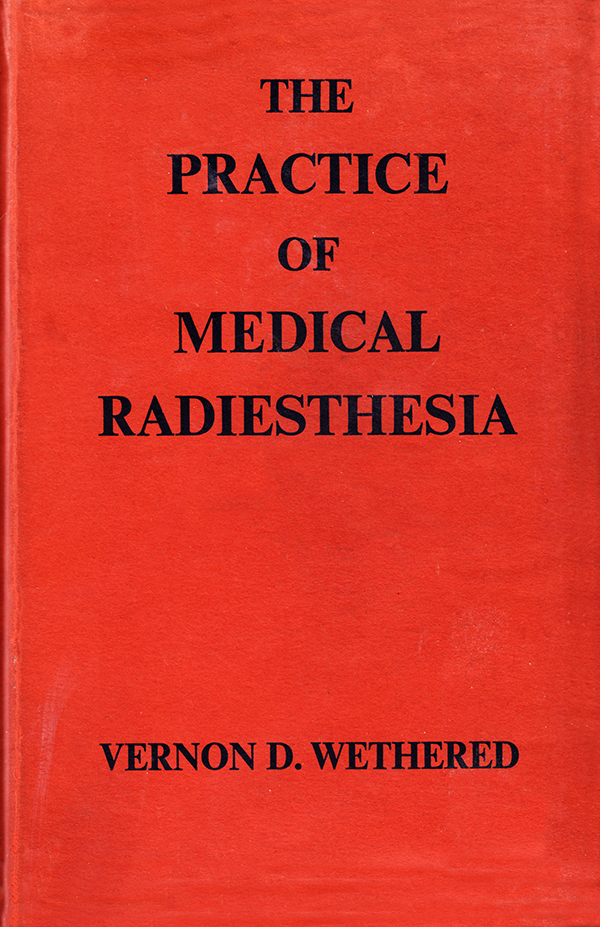
Whitlock, Ralph. Water Divining and Other Dowsing: A Practical Guide
Newton Abbot, David & Charles, 1982.
144 pages. Hardcover
Robert Hale Ltd; 2nd edition, 1992
160 pages.Paperback.I hope to obtain a copy of this book in the future. In the meantime, here is an Amazon review by SarahC:
" If you can dowse, then you need this book. It explains exactly whats going on and how to read your findings. Follow the instructions and you can judge the depth, flow rate and direction of flow of underground water sources, find static bodies of water, and even decide if its fit to drink or an old septic tank. Several dowsing and divining techniques are described in detail including water divining, map dowsing, and divining by affinity.
Skeptics can pick up a pair of rods, follow the beginners' instructions and see for themselves if they have the knack or not. You don't use loose metal sitting in a handle. Just use 2 bits of bent metal cut from wire coat hangers. The trick is to hold the sticks tightly and have your arms bent slightly and held under tension. If you can dowse then the bars will actually squirm in your hands. It's disconcerting the first time it happens."
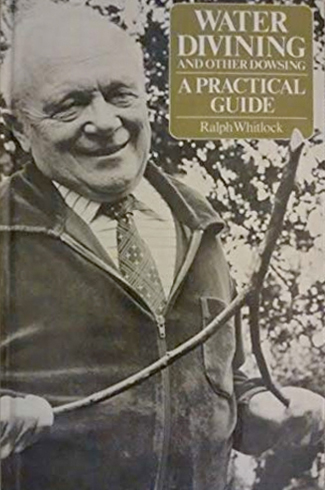
Willey, Raymond Clyde. Modern Dowsing: The Dowser's Handbook.
Cottonwood, AZ, Esoteric Publications, 1975.
196 pages, Paperback, illustrated with photographs.
Reprinted: New Mexico, Treasure Chest Publications, 1984.
with new line-art illustrations and a new preface by Oscar T. Branson (q.v.).The emphasis on water-witching in this fine manual of traditional dowsing technique belies the word "Modern" in its title. Little did Raymond Willey know that within ten years his "Modern" methods would become Old-School, and that the word "Modern" would thereafter apply to psychological and passive dowsing methods primarily associated with spiritual self-divining or introspective dowsing of the mind. I place this in my Top Ten Dowsing Books. It is a classic.
Back cover biography and blurb:
"Raymond Clyde Willy attended both Middlebury and Bowdoin colleges. As an adult his industrial assignments involved the gathering of statistical data concerning manufacturing processes for evaluations determining future application. A qualified professional expertise in observation and analysis resulted.
"In 1951 personal skill in map dowsing was discovered, which led to an intensive search into the fascinating field of dowsing, in all of its varied aspects. Discovering the confliction in terminology amid a scattered array of data and methods, Mr. Willey has undertaken the organization of his experiences and systems into a composite consolidation. This book is the result.
"After seven years of practice Mr. Willey took part in the 158 organizational meeting of the American Society of Dowsers, Inc. in Danville, Vermont. He has served as a trustee since the beginning of the society and has fulfilled eight years as secretary as well as editor of its quarterly publication, The American Dowser. He has met dowsers from all parts of the world and incorporated his gathered data into this book.
"Primarily intended for the beginning dowser, this book can serve as a handbook for reference by the layman and professional alike. It can supply a foundation for development of individual dowsing skill."
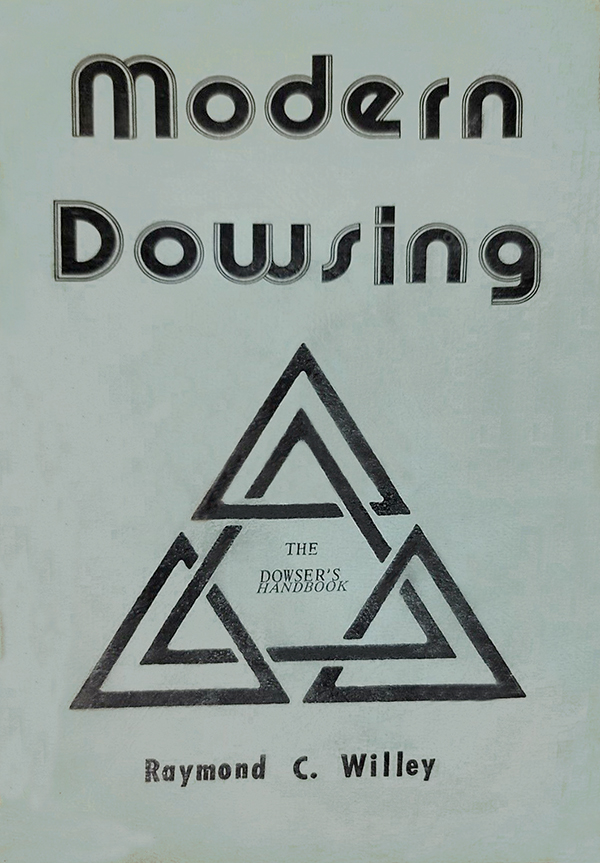
Williams, Anne. The Pendulum Book of Charts.
New York City, New York, Tower Press, 1979. Reprinted many times.
24 pages.This is a slim pamphlet, but valuable enough to learners that it went through nine printings from 1979 to 2009, and is still in print. The author presents a series of arc-shaped charts for pendulum readings on a table (as opposed to field or land readings), and the topics covered are more personal than pragmatic. In other words, rather than the search for potable water or buried minerals, Williams encourages informational dowsing, in which the pendulum dowser is to ask questions relating to personal issues. The rise of this introspective and psychological approach to pendulum consultation marked the beginning of a split between active pendulum dowsing and passive pendulum divination -- a split between Old-School Dowsing and New-Age Dowsing that widened through the course of the later 20th and early 21st centuries.
Of all the pendulum chart books, this is the only one i found of value, as there are only 7 charts (Mood, Food, Tolerance and Actual Stress, Colors for Healing, The Profession Indicator, The Yes-No Chart, and The Nutrient Chart), and each one is accompanied by a page or more of instructional material. I still don't like pendulum chart books, but with a 1979 publication date, this one is so early that it recommends itself to researchers on that account alone.
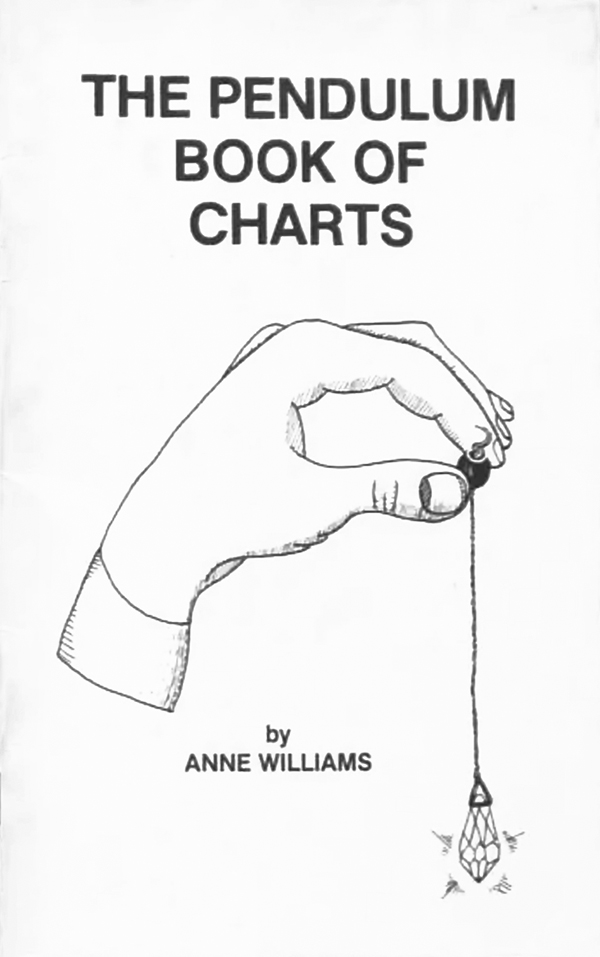
Williamson, Tom. Dowsing: New Light on an Ancient Art
Robert Hale, 1993.
220 pages. Photos.
Wolfe, Sam. Dowsing for Treasure and Minerals.
Wilmington, NC, Old South Publishing, 1974.
72 pages [66 pages + maps], paperback.Sam "Lobo" Wolfe taught field and map dowsing and also manufactured his own dowsing tools for sale. He was the first to obtain a U.S. patent on the design of an L-rod. His focus of interest, as the title of this book makes clear, was practical dowsing. Wolfe created a nation-wide organization, the United Dowsers Association (UDA), basd in La Puente, California, that promoted all forms of dowsing. During the 1970s the organization published a glossy magazine for its members that covered everything from water wells and mining to radionics, physical healing, and aura-mapping. Lobo and his wife Alma repeatedly traversed America in a motor home, hosting hands-on dowsing seminars at Holiday Inns. The Tucson Dowsers have scanned copies of the United Dowsers magazine online in pdf form for free reading at http://tucsondowsers.net/resources
Woods, Walt. Letter to Robin: A Mini-Course in Pendulum Dowsing.
The Print Shoppe, 1996
20 pages. Comb-bound.
10th Revision. March 2001This is the epicenter of the rule-bound New-Age method of pendulum dowsing. The pendulum itself is described as "simply a read-out, interface, or communication device [...] controlled through or by your subconscious, or something of that nature."
To consult a pendulum, you are to begin by "making an appointment with your Subconscious or Spirit Guides."
Next you must "obtain permission" to dowse. This is accomplished by jumping through the hoops of a bizarre "May I? Can I? Should I?" self-induction process in which you have to say -- out loud -- “May I, Can I, Should I, ESTABLISH, CHANGE or ADD Dowsing Conditions and Agreements or Programs which will be continually in effect until changed by me?" [Captialization as given.]
If the pendulum indicates a "Yes," you must then say -- out loud -- "End of prearranged conditions and agreements, thank you,” before going on to interrogate yourself about informational, soft-target questions.
But you are not finished yet, for after obtaining your answers, you must make a "final check" and "Ask the Dowsing System, 'Are the Conditions or Changes acceptable as presented, being clear and non-contradictory, and open to change by my request?'”
If the answer to that question is "Yes," then you are done with "the three step installation program." If not, you have to start all over again.
Next come the "Don'ts": "Be very careful not to interfere with anyone’s 'Lessons in Life' or possibly their 'Karma' or other unknown areas, that are best left ALONE" and "Never dowse a person without their personal request" and "Do Not diagnose or give medical advice of any kind!!"
Although Walt Woods claimed that his restrictive "Mother-may-i" technique was "based on the input of over 150 skilled dowsers," i had never heard anything like it in my decades of dowsing, and it struck me as an example of unmedicated obsessive-compulsive disorder in action.
I do not recommend this mechanistic pendulum method to anyone. I regard it as fear-driven, self-crippling, and antithetical to the practice of divination.
Walt Woods, was the president of the American Society of Dowsers and presided over its pivot from traditional dowsing to navel-gazing New-Age introspection. After his death, "Letter To Robin" was released as a free pdf. It is available all over the web in both print and free digital electronic form and is no doubt confusing the hell out of young dowsers right now, even as i write these words.
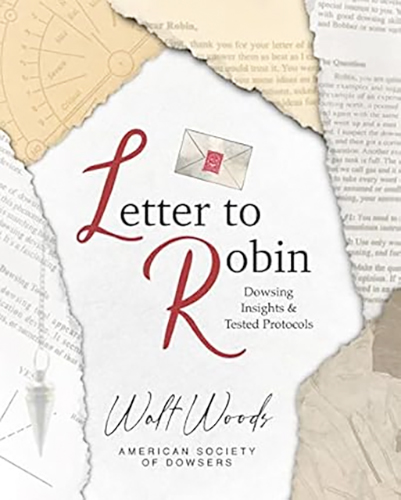
Woods, Walt. Companion to Letter to Robin: Learning to Dowse -- Student Guide and Teachers' Syllabus.
2004; 5th Revision, 2005.
25 pages.Here we have more of Walt Woods and his New-Age recasting of dowsing tools as "dowsing systems," and his description of using such a "system" as a form of "programming."
Like Walt Woods's original "Letter to Robin," this text has intentionally been made available in print and for free in digital electronic form and continues to spread his spirit-throttling mechanistic orthodoxy over the entire field of dowsing, like a dark cloud of polluted air.
Wyman, Walker D. Witching for Water, Oil, Pipes, and Precious Minerals.
River Falls, Wisconsin, University of Wisconsin - River Falls Press, 1977.
PART TWO: TITLES NOT IN ENGLISH
Benedikt, M. Ruten-und Pendel-lehre.
Vienna, Leipzig, 1917.
Carrie, Abbe. L'hydroscopographie et Metalloscopographie, ou l'art de Decouvrir les Sources et les Gisement Metallifers au Moyen de l'Electro-Magnetisme.
Saintes, France, 1863.
Chevreul, M. E. De la Baguette Divinatoire, du Pendule dit Explorateur, et des Tables Tournantes.
Paris, 1854.
De Morogues, Baron. Observations sur le fFluide Organoelectrique.
Paris, 1854.
De Vallemont, Abbe. La Physique Occulte, ou Traite de la Baguette Divinatoire.
Paris, 1693.
Holly, Dr Theodose A. Notions Methaphysiques et Autres, Revelees ou Confirmees par la Radiesthesie: Dieu et L'Univers (Mecanisme Du Monde) - Tome I
Port-au-Prince, Haiti, Imp. V. Valcin, n.d. [circa 1940],
6 1/8" x 9" tall, paperbound wraps, 144p. plus table of contents.
Klinckowstroem, Graf von. Virgula divina. Ein Beitrag zur Geschichte der Wuenschelrute.
Berlin, 1910.
Nicolas, Jean. La Verge de Jacob, ou l'Art de Trouver les Tresors les Sources, les Limites, les Metaux, les Mines, les Mineraux et Outres Cachees, par l'Usage du Baton Fourche.
Lyons, France, 1693. Translated as Jacob's Rod.
Rocard, Y. Le Signal du Sourcier.
Paris, Dunod, 1964.
PART THREE: ARTICLES IN PERIODICAL MAGAZINES
For a similar bibliography covering articles on dowsing, water-witching, and doodlebugging published in periodical magazines prior to 1982, see:
Hansen, George P. Dowsing: A Review of Experimental Research.
Journal of the Society for Psychical Research. Vol. 51, No. 792, pages. 343-367, October, 1982.A digital electronic version of Hansen's bibliography is also available at Hansen's own web site, Trickster Book.
http://www.tricksterbook.com/ArticlesOnline/Dowsing.htm (accessed 08/09/2010)
PART FOUR: ACKNOWLEDGEMENTS
Thanks to Richard Webster and Stuart Palm for contributions, and to my dear husband nagasiva yronwode for help with site maintenance, image scanning, and coding.
